
%20(2).svg)

Furnace Repair in Plano, TX
A furnace failure in Plano, TX does not feel dramatic until it happens on a 28-degree night in January. North Texas winters are short, but when cold fronts push temperatures into the 20s and 30s, a home without working heat becomes uncomfortable fast and potentially unsafe for young children and elderly family members. At DT Air Conditioning & Heating, our approach to furnace repair in Plano, TX is built on three principles: arrive fast, diagnose accurately, and fix it right the first time without upselling repairs you do not need.
Whether your furnace is producing no heat, cycling on and off repeatedly, making unusual noises, or simply running without warming your home, our licensed HVAC technicians have the diagnostic experience and the equipment to identify the problem and correct it. This guide covers the most common furnace failures, how to troubleshoot before you call, when replacement makes more sense than repair, and what to expect from our service.
What Does Furnace Repair in Plano, TX Include?
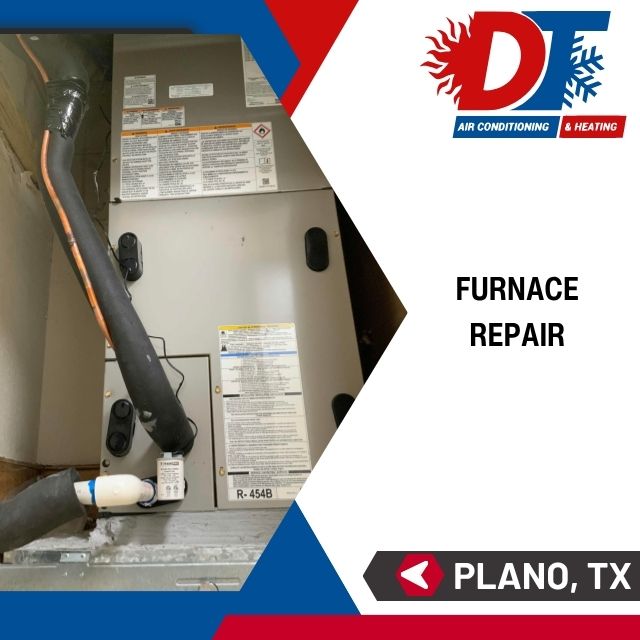
Furnace repair in Plano, TX is the professional diagnosis and correction of any malfunction in a gas or electric forced-air heating system. Common repairs include igniter replacement, flame sensor cleaning, gas valve adjustment, heat exchanger inspection, blower motor repair, control board replacement, thermostat diagnosis, and safety switch reset. A licensed HVAC technician identifies the root cause of failure, completes the repair using quality parts, and verifies safe, correct operation before leaving. DT Air Conditioning & Heating provides same-day and emergency furnace repair service throughout Plano with upfront pricing and no surprise charges.
Warning Signs Your Furnace Needs Professional Repair in Plano, TX
Furnace problems rarely appear without warning. Catching the early signs and scheduling a repair before a complete failure keeps you warm and keeps repair costs lower. Watch for any of the following:
- The furnace runs but your home is not reaching the temperature set on the thermostat
- The system cycles on for a short period and then shuts off before completing a full heating cycle, known as short-cycling
- You hear unusual sounds such as banging, popping, rattling, screeching, or persistent clicking when the furnace tries to start
- The pilot light or ignition attempts repeatedly but the burners do not light
- The burner flame is yellow or orange rather than a steady blue
- Your energy bills have increased significantly without a change in how you use heat
- There is a persistent burning smell, sulfur odor, or metallic scent coming from the vents
- Some rooms are heating properly while others remain cold despite the furnace running
- The furnace has not been serviced in more than a year and is behaving erratically
None of these symptoms resolve on their own. Acting quickly — especially with gas furnace issues — protects both your comfort and your safety.
What Is a Common Failure for a Furnace?
Gas furnaces in Plano, TX share a predictable set of failure points that our technicians diagnose and repair on a daily basis during winter service calls. Here are the most common:
Igniter Failure
The igniter is the component that lights the gas burners. In modern furnaces, this is typically a hot surface igniter — a small silicon nitride element that glows red hot to ignite the gas. Igniters are one of the most frequently replaced parts in a gas furnace because they degrade with each heating cycle over time. Symptoms include the furnace clicking and attempting to start repeatedly but producing no heat. Igniter replacement is a straightforward repair that restores full furnace function.
Dirty or Faulty Flame Sensor
The flame sensor is a safety component that detects whether the burners are actually lit after ignition. When it is coated with residue from combustion, it cannot read the flame accurately and shuts the system down as a safety measure — even though the burners are working correctly. A dirty flame sensor is one of the most common causes of furnace short-cycling and is typically resolved by cleaning or replacing the sensor rod.
Blower Motor Failure
The blower motor pushes heated air from the heat exchanger through your ductwork and into your living spaces. When the motor capacitor weakens, the motor bearings wear, or the motor itself fails, the furnace may produce heat but deliver little or no warm air to the rooms in your home. Blower motor issues often announce themselves with a humming sound, a grinding noise, or reduced airflow from registers.
Cracked Heat Exchanger
The heat exchanger is the metal component that separates combustion gases from the air circulating through your home. A cracked heat exchanger is a serious safety issue because it can allow carbon monoxide to enter your living space. Cracks are more common in older furnaces and those that have operated with restricted airflow over time. If our technicians discover a cracked heat exchanger, we will explain clearly what it means and what your options are.
Failed Control Board
The control board is the furnace's circuit board, coordinating ignition timing, blower operation, and safety shutoffs. Control board failures can produce a wide range of symptoms — from complete furnace shutdown to erratic cycling behavior — and require diagnostic equipment to confirm before replacement.
Gas Valve Issues
The gas valve controls the flow of natural gas to the burners. A valve that is failing or has lost calibration may cause weak or inconsistent burner flames, delayed ignition, or complete failure to light. Gas valve repairs and replacements require a licensed technician and should never be attempted by a homeowner.
Thermostat Malfunction
Before assuming the furnace itself is the problem, a faulty thermostat is always worth ruling out. A thermostat that is miscalibrated, has dying batteries, or has failed entirely can prevent the furnace from receiving an accurate signal to start, resulting in no heat even when the furnace is mechanically sound.
What Is the First Thing to Check When Your Furnace Is Not Working?
Before calling for service, there are several quick checks a homeowner can perform safely that sometimes resolve the problem without a service call. Go through this sequence in order:
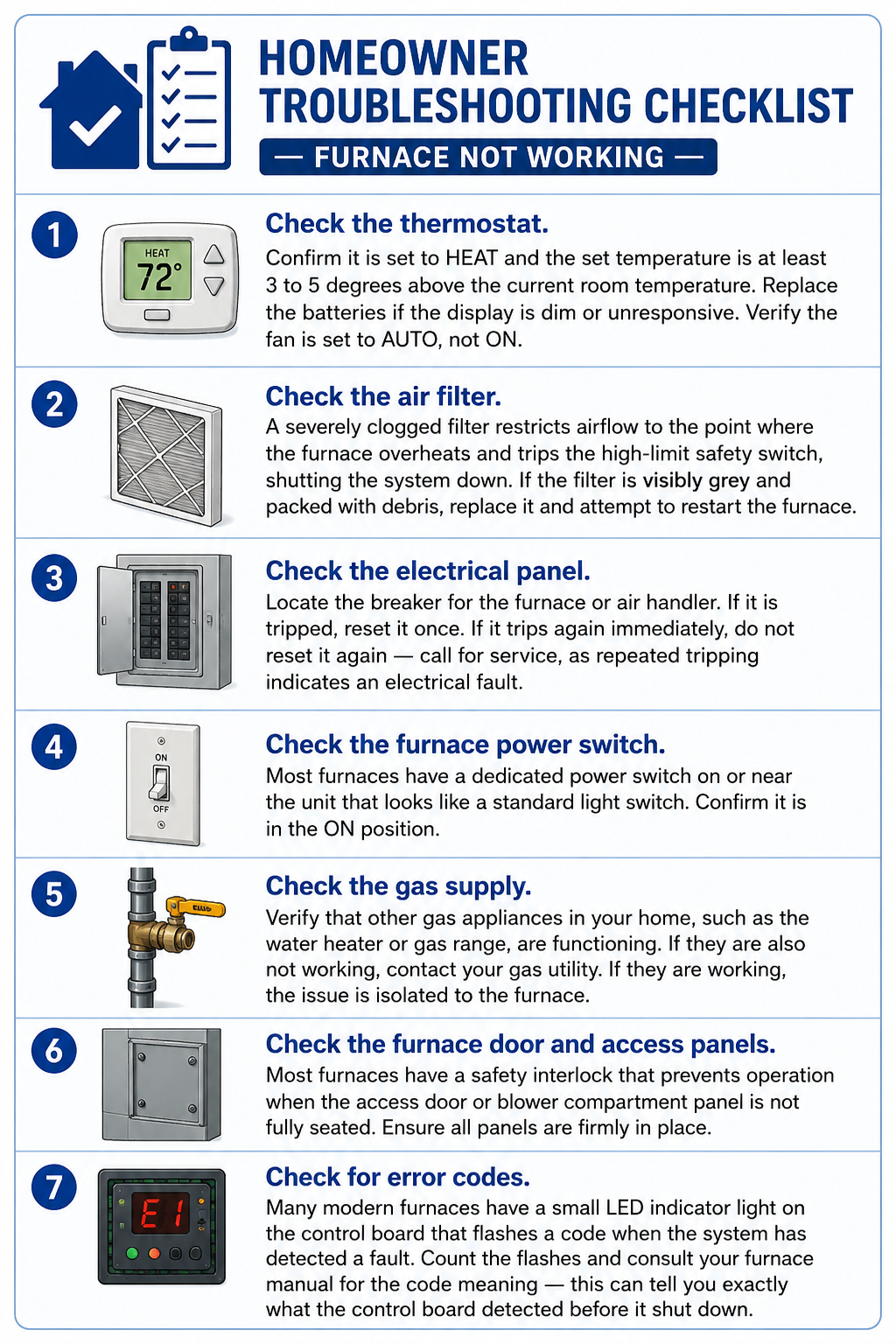
If you have worked through this list and the furnace still does not operate, the problem requires professional diagnosis. Call our team at 972-633-9343 and we will get a technician to you as soon as possible.
Safety Note: Gas Odors and Carbon Monoxide
If you smell natural gas (a sulfur or rotten egg odor) near your furnace, do not attempt any troubleshooting. Leave the home immediately, leave doors open as you exit, do not operate any electrical switches, and call your gas utility from outside or from a neighbor's home. Carbon monoxide is odorless and colorless — if your CO detector is alarming, treat it with the same urgency and evacuate before calling for help.
How Do I Know If My Furnace Needs Replacing in Plano, TX?
Not every furnace repair is worth making. At a certain point, the cost of continued repairs, combined with declining efficiency and reliability, makes replacement the smarter long-term decision. Here are the factors our technicians weigh when helping Plano homeowners make this call:
Age of the System
Gas furnaces have a typical service life of 15 to 20 years when well maintained. A furnace that is 15 years or older and facing a major component failure — cracked heat exchanger, failed control board, or blower motor replacement — is generally a stronger replacement candidate than repair candidate, particularly because additional failures are likely in the near term.
The $5,000 Rule Applied to Furnaces
Multiply the age of the furnace (in years) by the cost of the proposed repair (in dollars). If the result exceeds $5,000, replacement typically delivers better long-term value than repair. A 16-year-old furnace facing a $400 repair equals $6,400 — replacement is likely the wiser path.
Cracked Heat Exchanger
A cracked heat exchanger on an older furnace is almost always a replacement scenario. The heat exchanger replacement itself is expensive, and on a furnace over 12 years old, the remaining useful life may not justify the investment. This repair also involves confirmed exposure to carbon monoxide risk that warrants urgency in the decision.
Repeated Repair History
If your furnace has needed service calls in each of the past two or three winters, you are in a pattern of cascading failures that will continue. A system that requires repairs every year is costing you more than the service invoices suggest — it is also costing you comfort, disruption, and the risk of a mid-winter failure.
AFUE Efficiency Below Current Standards
Older furnaces operate at 78 to 80 percent AFUE, meaning 20 to 22 cents of every dollar spent on natural gas is wasted. Modern high-efficiency furnaces operate at 95 to 98 percent AFUE. In Plano's climate where heating seasons are short but cold fronts are sharp and unpredictable, upgrading efficiency may not be the primary driver — but it is a meaningful benefit worth factoring into the replacement decision.
.png)
If our inspection reveals that replacement is the more practical path, we will walk you through the options with no pressure. You can also review our furnace installation services in Plano, TX page for a full overview of the installation process, system sizing, and efficiency considerations.
What Is the Average Lifespan of a Furnace in Plano, TX?
The national average service life for a gas furnace is 15 to 20 years. In Plano and the broader North Texas market, furnace lifespan is influenced by several local factors that affect how systems age:
- Shorter but intense heating seasons: Plano furnaces do not run as many total hours per year as systems in colder northern climates. However, the sudden onset of cold fronts means furnaces are called upon to perform immediately and at full capacity, rather than warming up gradually through a long fall. This on-demand stress, combined with periods of dormancy, can affect igniter and electrical component longevity.
- Humidity and condensation: North Texas homes experience humidity swings that create condensation in heat exchangers and flue systems over time. This accelerates corrosion in older systems, particularly those without sealed combustion designs.
- Maintenance history: This is the single largest variable in furnace lifespan. Systems that receive annual professional tune-ups and consistent filter changes routinely reach 18 to 20 years. Those that operate without maintenance commonly develop major failures at 10 to 12 years.
- Quality of original installation: Improper gas pressure, incorrect venting, and poor duct connections established at installation create ongoing stress that shortens system life regardless of how well it is maintained afterward.
- Equipment quality tier: Builder-grade systems installed in new construction typically have a shorter service life than mid-grade or premium systems. Many homes in Plano's established neighborhoods are now at or approaching the age where their original furnace is ready for replacement.
Annual professional maintenance is the most effective way to maximize furnace lifespan and protect your investment. Explore our furnace maintenance services in Plano, TX to find a maintenance plan that keeps your system performing reliably through every heating season.
What Our Furnace Repair Service in Plano, TX Covers
DT Air Conditioning & Heating technicians are trained and equipped to diagnose and repair all major residential gas and electric furnace brands, including Carrier, Trane, Lennox, Rheem, Goodman, American Standard, York, Ruud, and Amana. Our repair service includes:
- Full system diagnostic with written findings and upfront repair pricing before any work begins
- Igniter testing and replacement
- Flame sensor cleaning and replacement
- Blower motor capacitor testing and replacement
- Blower motor replacement
- Gas valve testing and adjustment or replacement
- Control board diagnosis and replacement
- Heat exchanger inspection with visual and combustion analysis
- Thermostat diagnosis, calibration, and replacement including smart thermostat installation
- Draft inducer motor testing and replacement
- Pressure switch and safety switch diagnosis
- Flue and venting inspection and correction
- Condensate system inspection on high-efficiency furnaces
- Filter replacement and airflow verification
We carry commonly needed parts on our service vehicles so most furnace repairs can be completed in a single visit. When specialty parts must be ordered, we communicate the timeline clearly and provide temporary solutions where possible.


Why Plano Homeowners Choose DT Air Conditioning & Heating for Furnace Repair
When your heat goes out in the middle of a North Texas cold snap, you need a company that shows up quickly, tells you the truth about what is wrong, and fixes it without padding the invoice. Here is how we approach every furnace repair call:
- Same-day and emergency furnace repair service available throughout Plano
- Licensed, insured technicians on every call — no subcontracting
- Upfront pricing with written estimates before any repair begins
- Honest recommendations: if replacement makes more sense than repair, we will tell you and explain why
- We service all major furnace brands without brand exclusivity
- Local knowledge of Plano's climate and the specific failure patterns that develop in North Texas heating systems
- Committed to completing most repairs in a single visit
Call us at 972-633-9343, stop by at 6713 Oceanview Drive, Plano TX 75074, or schedule online at www.dt-ac.com/contact.
Frequently Asked Questions
How much does furnace repair cost in Plano, TX?
Furnace repair costs vary depending on the component involved, the age of the system, and parts availability. Minor repairs such as igniter or flame sensor replacement are generally on the lower end of the cost range. Blower motor and control board replacements represent mid-range costs. We provide a written, itemized estimate before any repair work begins so you know exactly what you are approving.
Is it safe to run my furnace if it is making a banging noise?
It depends on the type of noise. A banging sound at startup is often caused by delayed ignition — gas accumulates in the burner chamber before igniting, producing a small explosion-like sound. This stresses the heat exchanger over time and should be diagnosed promptly. A banging or rattling during operation can indicate a loose panel, blower wheel issue, or duct expansion. A high-pitched screeching or grinding noise typically means a motor bearing is failing. Any unusual furnace noise warrants a service call rather than continued operation.
How long does a furnace repair take?
Most standard repairs, including igniter replacement, flame sensor service, and capacitor replacement, are completed in one to two hours. Control board or blower motor replacement may take two to four hours. When specialty parts need to be ordered, we communicate the expected timeline and discuss temporary solutions if applicable.
Do you offer emergency furnace repair in Plano, TX?
Yes. We understand that furnace failures do not wait for business hours, particularly when temperatures drop sharply overnight. Contact us at 972-633-9343 to discuss emergency and same-day furnace repair availability throughout Plano.
What brands of furnaces do you repair?
We service all major residential gas and electric furnace brands including Carrier, Trane, Lennox, Rheem, Goodman, American Standard, York, Ruud, Amana, and others. If you are unsure whether we service your specific model, call us and we will confirm before you schedule.
What is the yellow flame in my furnace, and is it dangerous?
A furnace burner should produce a steady blue flame. A yellow or orange flame indicates incomplete combustion, which typically means the burner is receiving an improper fuel-to-air mixture. This is a condition that can produce elevated carbon monoxide output and should be evaluated by a technician as soon as possible. Do not continue operating the furnace until the cause is identified and corrected.
How can I avoid future furnace breakdowns?
The most effective prevention is annual professional maintenance scheduled each fall before heating season begins, combined with regular filter changes every one to three months. Our furnace maintenance services in Plano, TX are designed to catch the early warning signs of component failure before they become a breakdown on a cold January night.