
%20(2).svg)

AC Condenser Repair in Plano, TX
Diagnosis, Honest Fixes, and the Right Decision for Your System
Your AC condenser unit is the outdoor workhorse of your home's cooling system. It runs through every degree of Plano's five-to-six-month cooling season, rejecting heat from inside your home to the outdoor air while exposed to blazing Texas sun, dust, pollen, cottonwood, and the occasional hailstorm. When it starts failing — or when a technician tells you it needs to be repaired or replaced — you deserve a clear explanation of what is wrong, why it happened, and what the honest options look like. At DT Air Conditioning & Heating, our AC condenser repair in Plano, TX starts with an accurate diagnosis of the actual problem before any repair recommendation is made.
This guide covers what the condenser unit does, how to recognize when it is failing, what causes condenser failures in Plano homes, how long it should last, and the framework for deciding whether repair or full system replacement is the right financial choice for your situation.


What Is AC Condenser Repair in Plano, TX?
AC condenser repair in Plano, TX is the professional diagnosis and correction of failures within the outdoor condenser unit of a residential air conditioning system. The condenser unit houses the compressor, condenser coil, outdoor fan motor, capacitors, contactors, and refrigerant connections. Common condenser repairs include refrigerant leak detection and repair at the coil or line connections, condenser coil replacement when corrosion has compromised the coil, condenser fan motor and capacitor replacement, contactor replacement, coil cleaning to restore heat transfer efficiency, and refrigerant recharge after leak repair. DT Air Conditioning & Heating provides written estimates before any condenser repair work begins, performs all refrigerant work under EPA Section 608 certification, and gives honest guidance on repair versus full system replacement based on system age and actual diagnostic findings.
What Your AC Condenser Unit Does and Why Its Condition Matters
The outdoor condenser unit is the half of your air conditioning system responsible for releasing heat. Understanding its role explains why a failing condenser affects the entire system's performance, not just the outdoor unit.
During normal operation, refrigerant arrives at the condenser as a high-pressure, high-temperature vapor — carrying the heat it absorbed from inside your home at the evaporator coil. Inside the condenser unit, this hot refrigerant flows through the condenser coil, which is a network of copper or aluminum tubing surrounded by thin metal fins. The outdoor fan pulls ambient air across these fins, and the heat transfers from the refrigerant to the outdoor air. As it releases heat, the refrigerant condenses from vapor back to liquid. The liquid refrigerant then flows back to the indoor unit to absorb more heat and repeat the cycle.
When the condenser cannot do its job effectively — because the coil is dirty, leaking, or damaged; the fan motor is failing; or the refrigerant charge is incorrect — the entire cooling cycle is compromised. The compressor works harder and runs hotter trying to overcome the reduced heat rejection, energy consumption increases, cooling output drops, and system components wear faster. A condenser problem left unaddressed becomes a compressor problem within one to two cooling seasons in Plano's demanding climate.
What Are the Signs of a Bad AC Condenser in Plano, TX?
Condenser problems develop gradually in most cases, and catching them before they reach the point of complete failure is both possible and worthwhile. Here are the signs that your outdoor condenser unit is struggling:
Reduced Cooling Performance With the System Running
If your AC system is running but your home is taking significantly longer than usual to cool down, or cannot maintain a set temperature during the hottest parts of the day, a compromised condenser is often the cause. A dirty condenser coil — packed with dust, pollen, grass clippings, or cottonwood — loses heat transfer efficiency and forces the compressor to work harder against elevated head pressure. A condenser coil with a slow refrigerant leak produces progressive cooling loss as refrigerant charge drops. Both conditions look identical from a comfort standpoint and both require professional diagnosis to distinguish.
The Outdoor Unit Is Running But Cooling Is Minimal or Absent
If you can hear and feel the outdoor unit running — the fan is spinning and the compressor is operating — but the air from your supply registers is warm or only slightly cooler than room temperature, the condenser coil may have lost its ability to reject heat effectively. This can result from a severely fouled coil, a refrigerant leak that has depleted the charge significantly, or a condenser coil failure that has compromised the refrigerant circuit integrity.
Ice Formation on the Refrigerant Lines or Indoor Coil
A condenser coil that is leaking refrigerant and causing the system to operate at low refrigerant charge can trigger ice formation on the suction line between the outdoor and indoor units, or on the indoor evaporator coil itself. The low-pressure, low-temperature refrigerant vapor in the suction line gets cold enough to freeze moisture in the surrounding air when charge is too low. Ice formation during cooling mode is never normal and always warrants immediate professional evaluation.
Elevated Energy Bills Without Increased Usage
A condenser coil coated with a season's worth of accumulated debris forces the compressor to operate at elevated head pressure, consuming more electricity per hour of operation to achieve the same cooling output. If your summer cooling bills are climbing year over year without a corresponding change in usage habits or thermostat settings, declining condenser coil efficiency is a likely contributor. This is one of the clearest financial arguments for annual condenser coil cleaning.
Unusual Sounds From the Outdoor Unit
A rattling sound from the outdoor unit may indicate debris trapped inside the condenser housing — a common occurrence in Plano when cottonwood season coincides with peak cooling demand. A grinding or squealing sound from the outdoor unit typically indicates a failing condenser fan motor bearing. A loud hissing or bubbling sound can indicate a refrigerant leak at a coil connection or service port. Each of these sounds requires different attention, and none should be ignored while the system continues to run.
Visible Damage, Bent Fins, or Corrosion on the Outdoor Coil
The aluminum fins on the condenser coil can be bent by debris, hail impact, or improper cleaning with high-pressure water. Bent fins reduce airflow through the coil, compromising heat transfer efficiency. Visible rust or green oxidation on copper coil tubing — particularly at brazed joints — indicates corrosion that may be the precursor to a refrigerant leak. Inspecting the outdoor unit periodically for visible fin damage and corrosion is one of the most useful things a homeowner can do between professional maintenance visits.
Oil Staining Around the Outdoor Unit or Line Connections
Refrigerant carries compressor oil throughout the system. A refrigerant leak at the condenser coil, the service valve connections, or the refrigerant line fittings will leave an oily residue at the leak point as the oil bleeds out with the refrigerant. Visible oily staining on the condenser housing, the base of the unit, or on the copper refrigerant line insulation near the outdoor unit is a reliable indicator of an active refrigerant leak that requires professional location and repair.
Why AC Condenser Coils Fail in Plano, TX: The Formicary Corrosion Problem
The most common cause of condenser coil failure in Plano homes is not physical damage — it is formicary corrosion, and it is more prevalent in North Texas than homeowners typically realize.
Formicary corrosion is a chemical reaction between formic acid and the copper tubing in the condenser coil. Formic acid is present in the outdoor air as a byproduct of environmental organic matter — decaying vegetation, vehicle exhaust, cleaning products, and other sources. When formic acid contacts copper in the presence of oxygen and water, it creates microscopic ant-trail-shaped pits in the copper tubing — hence the name, from the Latin for ant. These pits eventually penetrate the tubing wall, creating tiny pinhole leaks that release refrigerant gradually.
The insidious aspect of formicary corrosion is its early invisibility. A coil that is developing corrosion-based pinhole leaks may show no visible signs of damage during a casual inspection. The refrigerant loss is slow — a few ounces per season — and the cooling performance decline is gradual enough that homeowners often attribute it to normal aging rather than an active leak. By the time the charge is low enough to produce obvious symptoms, the compressor has typically been operating under stress for months.
Plano's outdoor air quality — including vehicle exhaust from high-traffic corridors and the VOC content of suburban landscaping chemicals — contributes to formicary corrosion rates that are notable in the Texas HVAC market. Annual condenser coil inspection during professional maintenance visits is the best way to catch corrosion-based leaks while they are still small enough to address cost-effectively.
What Is the Lifespan of an AC Condenser in Plano, TX?
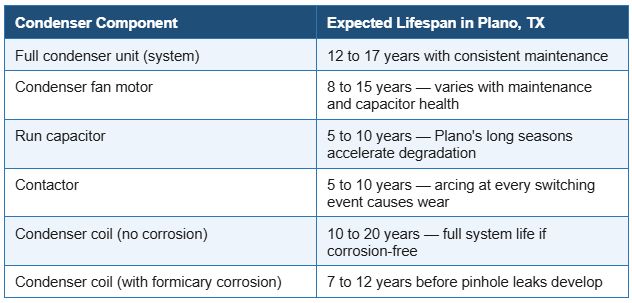
The condenser unit as a whole — housing, coil, fan motor, and electrical components — has an expected service life that mirrors the full system: 12 to 17 years with consistent maintenance in Plano's climate. The individual components within the condenser unit have different lifespans, and understanding which components fail earliest informs both maintenance priorities and replacement decisions.
Condenser Fan Motor: 8 to 15 Years
The outdoor condenser fan motor runs continuously whenever the system operates, pulling air through the coil fins. In Plano's climate, where the system runs for five to six months at high demand levels, fan motor bearing wear, capacitor-related hard-start damage, and insulation degradation from sustained heat exposure are the most common failure modes. Annual motor amp draw testing and capacitor replacement before failure keeps fan motors running toward the longer end of their service range.
Run Capacitor: 5 to 10 Years
The run capacitor for the condenser fan motor and compressor degrades measurably with every operating hour, losing capacitance as the dielectric material inside breaks down from heat exposure. In Plano's long cooling seasons, capacitors that might last 8 to 10 years in a cooler climate often reach end of useful life in 5 to 7 years. Proactive replacement during a maintenance visit when the capacitor measures below rated specification costs a fraction of what a capacitor failure costs in emergency service charges and secondary motor damage.
Condenser Coil: 10 to 20 Years, Depending on Corrosion Exposure
A condenser coil that avoids significant corrosion exposure and physical damage can last the full life of the system. A coil subject to formicary corrosion, hail damage, or aggressive chemical cleaning may develop pinhole leaks in 7 to 12 years. Annual coil inspection and keeping the coil surface clean — clean coils corrode more slowly because debris traps moisture against the metal surface — are the two most effective ways to maximize condenser coil life.
Contactor: 5 to 10 Years
The electrical contactor switches high-voltage power to the compressor and condenser fan motor each time the thermostat calls for cooling. Every switching event creates an arc that gradually pits the contact surfaces. A contactor with visibly pitted or burned contacts can cause hard-starting, intermittent operation, and eventual failure to make contact. Like capacitors, contactors are tested and replaced proactively during annual maintenance visits.
Is It Worth Repairing an AC Condenser in Plano, TX?
The answer depends heavily on which part of the condenser has failed, the age of the system, and whether the failure is isolated or a symptom of broader system wear. Here is how to think through the decision:
Repairs That Are Almost Always Worth Making
Fan motor replacement, capacitor replacement, contactor replacement, and refrigerant recharge after a confirmed and repaired leak are all repairs that make financial sense at virtually any system age. These are components with defined repair costs that are straightforward to address, and they do not carry the same cost-to-system-value ratio considerations that coil and compressor repairs do.
Condenser Coil Repair or Replacement: Evaluate Carefully
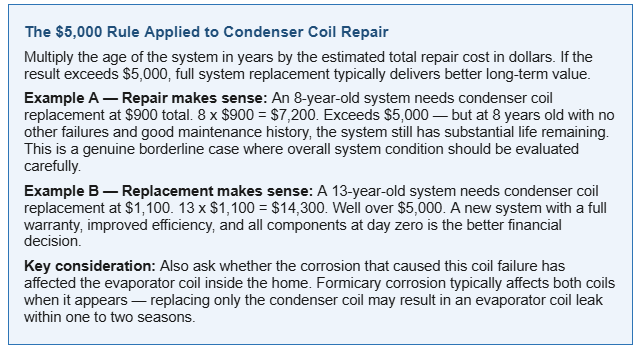
Condenser coil replacement is a significant repair. The coil itself carries substantial parts cost, and the repair requires complete refrigerant recovery, coil replacement, system evacuation, and recharge. On a system under 8 to 10 years old in otherwise good condition, coil replacement is generally worth the investment — the system still has meaningful remaining service life, and the coil is the primary failed component. On a system over 12 years old, coil replacement cost compared to new system cost deserves a direct calculation.
R-22 Refrigerant Systems: The Replacement Tipping Point
If your system uses R-22 refrigerant — phased out of production in 2020 — a condenser coil failure that requires refrigerant recharge becomes a much stronger replacement argument. R-22 refrigerant is expensive and increasingly difficult to source. Investing in condenser coil replacement on an R-22 system commits you to ongoing high refrigerant costs for every future service need. Replacement with a current-refrigerant system eliminates this cost profile permanently.
The Root Cause Evaluation Before Any Major Repair
Before authorizing condenser coil replacement, confirm that the technician has identified and addressed the cause of the coil failure. A replacement coil installed without addressing formicary corrosion contributing factors, or without repairing a leak source that was the root cause of refrigerant loss, is at elevated risk of the same failure. Our technicians evaluate the full system context before any condenser coil repair recommendation.
How DT Air Conditioning & Heating Approaches AC Condenser Repair in Plano, TX
Every condenser repair begins with a systematic evaluation that identifies the specific failure and its underlying cause:
- Visual inspection of the condenser unit. We inspect the coil fins for bent or packed debris, check for oil staining that indicates refrigerant leaks, assess the fan motor and blade condition, and inspect the electrical compartment for contactor and capacitor condition.
- Refrigerant pressure measurement. We measure suction and discharge pressures to evaluate system charge and compressor performance. Low suction pressure combined with warm supply air is a classic indication of low refrigerant charge from a condenser coil leak.
- Electronic and UV dye leak detection. We use electronic refrigerant leak detectors to locate active leak sites at the condenser coil, line connections, and service ports. For confirmed leaks where the source is not immediately obvious, UV dye injection and UV light inspection identifies the precise leak location.
- Electrical component testing. We test the run capacitor against rated µF specifications and measure contactor contact resistance. Failed or below-spec components are replaced before refrigerant recharge.
- Fan motor amp draw testing. We measure the outdoor fan motor's operating current against the nameplate rating to identify motors that are drawing elevated amps — an indicator of bearing wear or impending failure.
- Written findings and options before any work is authorized. After completing the diagnostic, we explain exactly what we found, provide the repair and full replacement options with pricing for each, and let you make an informed decision before any work begins.
Related AC Services in Plano, TX
AC Leak Repair
Every condenser coil repair involving refrigerant loss requires a confirmed leak location and repair before recharging. Our AC leak repair services in Plano, TX cover the full range of refrigerant leak detection, leak repair, and system recharge services.
AC Compressor Repair
A condenser coil problem that has allowed the system to operate with low refrigerant charge or elevated head pressure for an extended period may have caused secondary compressor stress. Our AC compressor repair services in Plano, TX page covers how we evaluate compressor condition after a condenser repair and what the decision framework looks like when both components are involved.
AC Parts Repair
For capacitors, contactors, fan motors, and other component-level repairs within the condenser unit and broader system, our AC parts repair services in Plano, TX page covers the full component repair scope and the cost framework for evaluating each type of repair.
Why Plano Homeowners Choose DT Air Conditioning & Heating for AC Condenser Repair
Condenser repair is a refrigerant system service — it requires EPA certification, proper equipment, and the technical knowledge to distinguish between a coil that can be cleaned and returned to service, one that needs targeted leak repair, and one that has been compromised to the point where coil or system replacement is the better path. Here is what we bring to every condenser service call:
- EPA Section 608 certified refrigerant handling on every repair involving the refrigerant circuit
- Electronic and UV dye leak detection to locate the precise leak source before any recharge
- Written estimates covering all options — targeted repair, coil replacement, or full system replacement — before any work is authorized
- Root cause evaluation before any major condenser repair to protect the replacement from the same failure
- Licensed and insured technicians on every call — no subcontracting
- Honest repair-versus-replace guidance based on system age, refrigerant type, and actual diagnostic findings
- Same-day and emergency service available when a condenser failure has left your home without cooling
Call us at 972-633-9343, visit us at 6713 Oceanview Drive, Plano TX 75074, or schedule at www.dt-ac.com/contact.