
%20(2).svg)

AC Replacement in Plano, TX
When your air conditioner is no longer doing its job, every homeowner faces the same uncomfortable question: is it worth fixing, or is it time to replace it? That question carries real financial weight, especially in Plano, TX, where your cooling system runs hard for five to six months out of the year. At DT Air Conditioning & Heating, we believe the answer should never be driven by a sales pitch. Our approach to AC replacement in Plano, TX starts with an honest assessment of your current system and ends with a new installation that is precisely sized, professionally completed, and built to last.
Whether your system has broken down unexpectedly, is approaching the end of its service life, or is simply costing you more every month to operate than a new unit would, this guide covers everything you need to know to make a fully informed decision.
What Is AC Replacement in Plano, TX?
AC replacement in Plano, TX means removing your existing air conditioning system and installing a new, correctly sized unit in its place. Replacement is typically the right choice when the current system is 12 to 15 or more years old, has experienced a major component failure, requires R-22 refrigerant, or is costing significantly more to operate and repair than a modern system would. DT Air Conditioning & Heating handles full system replacement including load calculation, equipment selection, old system removal, new system installation, ductwork inspection, refrigerant charging, and final performance testing.
Clear Signs It Is Time for AC Replacement in Plano, TX
Not every AC problem calls for a full replacement, but some situations make it the obvious choice. Here are the signs our technicians see most often that point toward replacement over repair:
- Age over 12 to 15 years: The average central AC system has a serviceable life of 12 to 17 years in a Texas climate. Systems in this range face escalating repair frequency and declining efficiency, making replacement the smarter long-term investment.
- Repeated breakdowns: If your system has needed repairs multiple times in the past two to three summers, you are likely paying to extend the life of a system that is already failing. A pattern of breakdowns reliably signals that more are coming.
- R-22 refrigerant dependency: R-22, commonly known as Freon, was phased out of production in 2020. Systems that still use it are expensive to service and cannot be recharged with a modern refrigerant without a full system overhaul.
- High energy bills that keep climbing: As components wear and efficiency degrades, your system uses more electricity to produce the same cooling. A modern high-efficiency system can significantly reduce cooling-related energy consumption.
- Major component failure: A failed compressor, condenser coil, or evaporator coil on an older system often costs as much or more to replace as a new system, without the reliability or efficiency benefits.
- Persistent comfort problems: Hot spots, rooms that never cool properly, and humidity issues that persist despite repairs often indicate a system that is undersized, aging, or both.
- Warranty has expired: Most manufacturer warranties on residential systems run 5 to 10 years. Once coverage ends, major repairs come entirely out of pocket.
If you are not certain whether replacement is the right step, our team will give you an honest read on your current system's condition. You can also review our AC repair services in Plano, TX page to understand how we evaluate repair versus replacement on a case-by-case basis.
What Is the $5,000 Rule for HVAC?
The $5,000 rule is a practical guideline that HVAC professionals use to help homeowners decide whether to repair or replace an aging system. It is one of the most reliable tools for cutting through the uncertainty of that decision.
How the $5,000 Rule Works
Multiply the age of your AC system (in years) by the estimated cost of the repair (in dollars). If the result exceeds $5,000, replacing the system is typically the wiser financial decision.
Example A — Repair makes sense: A 4-year-old system needs a $600 capacitor repair. 4 x $600 = $2,400. Well under $5,000. Repair it.
Example B — Replacement makes sense: A 12-year-old system needs a $700 repair. 12 x $700 = $8,400. Over $5,000. Replacement is likely the smarter move.
The logic behind this rule is sound: older systems cost progressively more to operate due to declining efficiency, and a repair that costs a few hundred dollars today often signals deeper wear that produces the next failure soon after. When you factor in the energy savings of a new high-efficiency system, the financial case for replacement on an aging unit becomes even stronger.
That said, the $5,000 rule is a starting framework, not an absolute verdict. If your system is 9 years old, well-maintained, and facing a borderline repair, we will walk you through the full picture — including energy savings projections, remaining warranty coverage, and realistic expectations for continued performance. Our recommendation is always what is actually right for your situation.
Is a 7-Year-Old AC Unit Old?
This is a question we hear often, and the honest answer is: no, a 7-year-old AC unit is not old, but it is entering the age range where your maintenance habits and the quality of the original installation start to determine everything.
Here is a realistic picture of where a 7-year-old system typically stands:

In most cases, a 7-year-old system with a reasonable maintenance history is worth repairing when it experiences a minor to mid-range failure. The question becomes more nuanced when major component failures or refrigerant issues are involved. A diagnostic appointment is the fastest way to get a clear, honest answer about where your system stands.
Can a 20-Year-Old AC Unit Be Repaired?
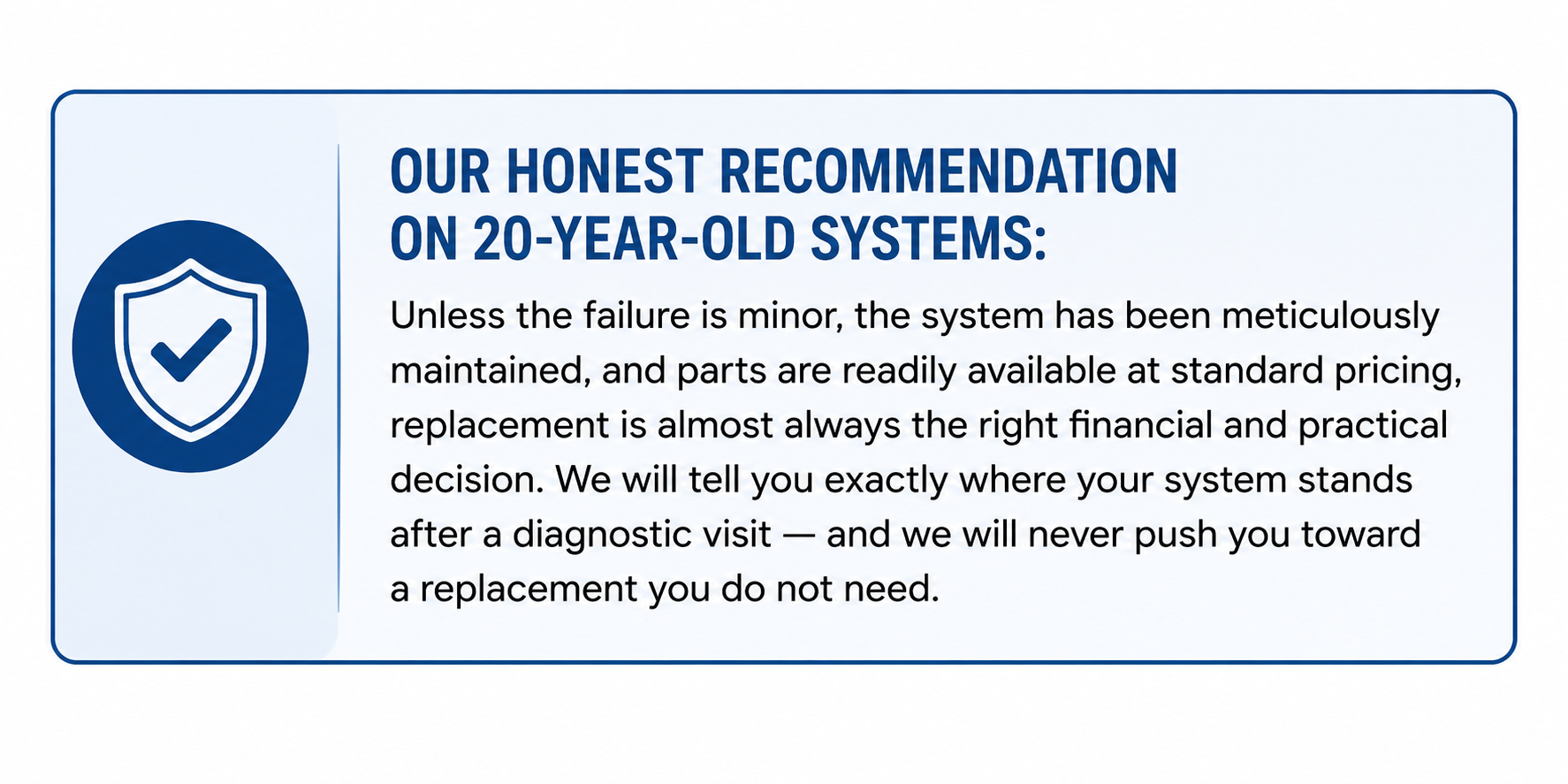
Technically, yes. A 20-year-old AC unit can often be repaired. Whether it should be is a different question entirely, and the answer in most cases is no.
Here is the practical reality of repairing a 20-year-old system in Plano:
Parts Availability
By 20 years, many manufacturers have discontinued parts for older model lines. When parts are available, they often come from specialty suppliers at a significant premium. When they are not, a repair becomes impossible without component substitution that can affect system performance and safety.
Refrigerant Costs
Most 20-year-old systems use R-22 refrigerant, which has not been manufactured since 2020. The remaining supply is limited and expensive. A refrigerant recharge on a 20-year-old system costs substantially more than the same service on a modern system using current refrigerants.
Efficiency Reality
A 20-year-old system operates at a SEER rating well below current minimum standards. Even if it is repaired and running, it uses substantially more electricity per hour of cooling than a modern system. That efficiency gap compounds into real money every month it runs.
The Compounding Failure Risk
When a 20-year-old system experiences one major failure, it is a reliable indicator that other components are at or near the same wear threshold. Paying to repair one component today often means facing another failure within one to two cooling seasons.
If your system has reached this point and you are ready to explore your options, our AC installation services in Plano, TX page walks through what to expect from the replacement process, including sizing, equipment selection, and installation timeline.
What Is the Most Expensive Part to Replace on an AC Unit?
Understanding the cost structure of AC components helps homeowners make better decisions when facing a major repair on an aging system. Here are the most significant component costs, from highest to lowest:
1. The Compressor
The compressor is the most expensive single component in a residential air conditioning system. It is the mechanical heart of the cooling process, and when it fails, the entire system stops cooling. Compressor replacement is a substantial cost, and when combined with associated labor, refrigerant recovery and recharge, and related component replacements, the total can approach or exceed the price of a new system on a unit that is 8 to 10 or more years old.
For systems still under compressor warranty, replacement makes clear sense. For older out-of-warranty systems, the math often favors full replacement over compressor repair.
2. The Condenser Coil
The outdoor condenser coil is where your system releases heat from inside your home to the outside air. Condenser coil failure — usually from refrigerant leaks caused by corrosion or physical damage — is a high-cost repair. The part is expensive, installation is labor-intensive, and the system must be evacuated and recharged with refrigerant as part of the process.
3. The Evaporator Coil
The indoor evaporator coil is where the cooling process occurs. Like the condenser coil, evaporator coil replacement involves complete refrigerant recovery, new coil installation, and a full system recharge. On an older system, coil corrosion often reappears within a few seasons even after replacement, limiting the long-term value of the repair.
4. The Air Handler and Blower Assembly
The air handler circulates conditioned air through your ductwork. Motor and blower failures are less costly than coil or compressor work but still represent a meaningful expense on an older system that may have other components approaching end of life.
If your system has experienced a compressor, condenser coil, or evaporator coil failure, our technicians will give you a clear side-by-side comparison of repair cost versus new system cost before you make any decision. For situations where repair is clearly the right call, visit our AC repair services in Plano, TX page.
Our AC Replacement Process in Plano, TX
At DT Air Conditioning & Heating, AC replacement is a precision process that determines how well your new system performs and how long it lasts. Here is exactly what we do:
- System assessment and honest recommendation. We inspect your current system thoroughly and give you a direct, data-based recommendation on whether replacement is justified. If repair is the better option, we will say so.
- Load calculation for correct system sizing. We perform a Manual J load calculation using your home's square footage, insulation values, window orientation, ceiling height, and local climate data. Guessing at tonnage produces an oversized or undersized system — both of which reduce efficiency and lifespan.
- Equipment selection and written estimate. Based on the load calculation and your budget, we present options at different efficiency tiers with a clear written estimate covering parts, labor, and any required ductwork or electrical work. No surprises.
- Permit pulling. We handle all required city permits before work begins. This protects your investment and ensures the replacement is documented for home sales and insurance purposes.
- Old system removal and responsible disposal. We disconnect, remove, and dispose of your old equipment, including proper refrigerant recovery in compliance with EPA regulations.
- New system installation. Our licensed technicians install your new air handler, outdoor condenser, refrigerant lines, and electrical connections to manufacturer specifications and Texas building codes.
- Ductwork inspection and sealing. We inspect your existing ductwork for leaks, undersized runs, or disconnections that would undermine the new system's performance, and address what we find.
- System startup and performance verification. We charge the system to manufacturer specs, test airflow at every register, verify all electrical components, and confirm target temperature is achieved before we leave.
- Documentation and walkthrough. We walk you through thermostat operation, filter maintenance schedule, and warranty documentation before closing the job.
Repair vs. Replacement: A Side-by-Side Comparison
If you are still undecided, this comparison covers the factors that most consistently determine which path makes more financial and practical sense for Plano homeowners:
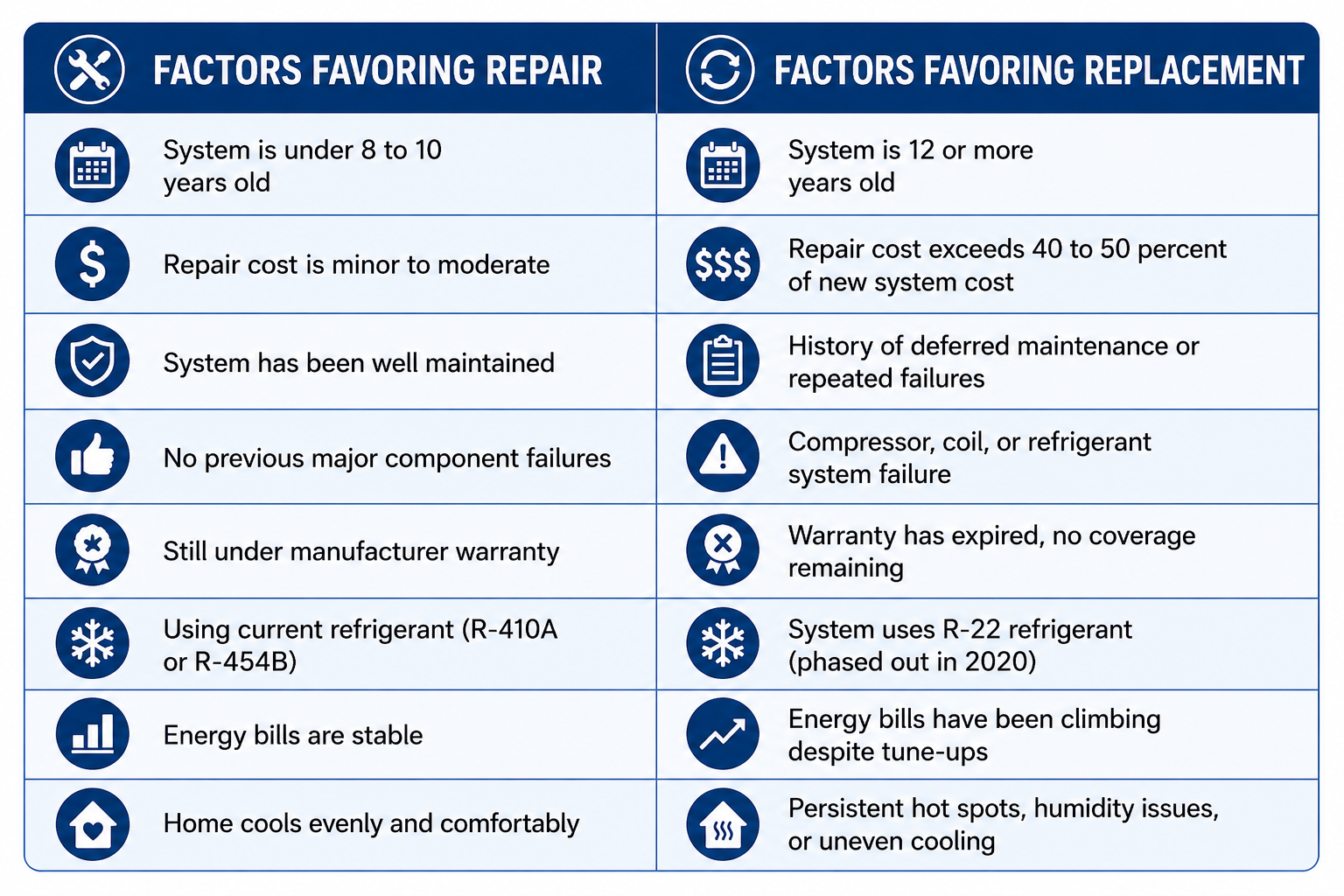
When multiple factors in the right column apply simultaneously, replacement is almost always the right call. Our technicians will help you quantify the decision by comparing the estimated total cost of continued repair and operation against the cost and projected savings of a new system.
Protect Your New System: AC Maintenance in Plano, TX
A new air conditioning system is a significant investment. The best way to protect that investment and maximize its service life is consistent preventive maintenance. Plano's summers are among the most demanding in the country for residential HVAC equipment, and systems that run for five to six months at full capacity need professional attention to perform reliably and efficiently year after year.
Our seasonal maintenance service includes a full inspection of electrical components and connections, cleaning of condenser and evaporator coils, refrigerant level verification, thermostat calibration, condensate drain system inspection, blower motor and fan inspection, and a complete operational test.
We recommend scheduling maintenance every spring before peak cooling season begins. Customers who maintain their systems consistently see fewer emergency service calls, lower monthly energy bills, and systems that reach or exceed their expected service life. Explore our AC maintenance plans in Plano, TX to find the right plan for your home.


Why Plano Homeowners Choose DT Air Conditioning & Heating for AC Replacement
Choosing the right contractor for AC replacement matters as much as choosing the right equipment. A system that is improperly sized or installed will underperform regardless of brand. Here is what our approach looks like in practice:
- We never recommend replacement when repair is the honest and practical choice
- Every system is sized using a proper load calculation, not a square footage estimate
- Licensed and insured technicians complete every installation with no subcontracting
- Written estimates before work begins with no hidden charges or surprise add-ons
- We carry and install multiple brands at different price points and recommend based on your needs
- We handle permits, refrigerant disposal, old equipment removal, and final inspection
- Post-installation support: if the system does not perform as expected, we come back
Reach us at 972-633-9343, visit us at 6713 Oceanview Drive, Plano TX 75074, or schedule your free assessment at www.dt-ac.com/contact.
Frequently Asked Questions
How long does AC replacement take?
Most standard residential AC replacements are completed in one day, typically four to eight hours. Jobs that require ductwork modifications or electrical upgrades may take longer. We provide a clear schedule estimate before work begins.
Do I need a permit for AC replacement in Plano, TX?
Yes. The City of Plano requires permits for HVAC equipment replacement. We pull all required permits as part of our replacement process. Unpermitted work can create complications during home sales, insurance claims, and future service calls.
What brands do you install for replacement?
We install multiple brands across different quality and efficiency tiers. Our recommendation is based entirely on your home's specific load requirements and your budget — not on brand relationships or margin preferences. We will explain exactly why we are recommending a specific system before any agreement is signed.
What SEER2 rating should I choose for my replacement system?
Texas requires a minimum SEER2 rating of 14.3 for new split-system installations. For Plano's climate, where systems run heavily for months at a time, upgrading to 16 to 18 SEER2 or higher typically delivers meaningful monthly savings that compound over the system's life. We will help you calculate the payback period for each efficiency tier so you can decide what fits your situation.
Do you offer financing for AC replacement?
Yes. Financing options are available for qualified customers to help manage the upfront cost of a new system. Ask our team about available plans when you contact us to schedule your assessment.
What happens to my old AC unit?
We handle complete removal and responsible disposal of your old system, including proper refrigerant recovery performed in compliance with EPA regulations. You do not need to coordinate disposal separately.
How do I know if my ductwork needs to be replaced along with the AC?
We inspect your existing ductwork as part of every replacement job. Leaky, undersized, or improperly configured ductwork will compromise the performance of even the best new system. If we find issues, we will show you exactly what we found and explain your options before any additional work is done.