
%20(2).svg)

AC Duct Repair in Plano, TX
Fix the Hidden Problem Draining Your Comfort and Energy Bills
Most Plano homeowners who call about high energy bills or rooms that never cool properly are focused on the AC unit itself. They have changed the filter, checked the thermostat, and wonder if the compressor is failing. In many cases, the actual culprit is invisible inside the walls and attic — a duct system that is leaking, disconnected, collapsed, or undersized, silently wasting 20 to 30 percent of every dollar spent on cooling. At DT Air Conditioning & Heating, our AC duct repair in Plano, TX starts with finding exactly what is wrong with your duct system before recommending how to fix it — because the right repair depends entirely on what is actually causing the problem.
Whether you have one room that stays warm no matter what, a system that runs constantly without satisfying, or ductwork that a technician has flagged as problematic, this guide covers when duct repair is the right answer, what the repair process looks like, how long ducts should last, and when targeted repair gives way to full replacement.
What Is AC Duct Repair in Plano, TX?
AC duct repair in Plano, TX is the professional identification and correction of leaks, disconnections, collapses, insulation failures, and airflow restrictions within a residential duct system. Common duct repairs include sealing leaking joints and connections with mastic sealant or metal foil tape, reconnecting separated flex duct sections, replacing collapsed or kinked flex duct runs, repairing damaged insulation on attic ductwork, correcting improperly sized branch ducts, and sealing supply boot connections at the ceiling or floor. DT Air Conditioning & Heating evaluates the full duct system before recommending repairs, provides written estimates, and verifies airflow improvement after every duct repair project.
What Leaking and Damaged Ducts Are Costing Your Plano Home
Duct leakage is the most pervasive and underdiagnosed energy problem in residential HVAC. The Department of Energy estimates that the average home loses 20 to 30 percent of conditioned air through duct leaks before it reaches the living space. In a Plano home running the AC system eight to ten hours per day from May through October, that translates directly into energy bills that are significantly higher than they should be — and a home that does not stay as cool as it should despite the system running hard.
Beyond energy waste, leaking and damaged ductwork creates a cascade of secondary problems:
- Comfort problems that look like equipment failures: A room that never cools properly, a second floor that stays 5 degrees warmer than the first, or a home that cannot reach set temperature on hot days are all classic duct symptoms that are frequently misattributed to an undersized or failing AC system. Before replacing equipment, the duct system should be evaluated.
- Equipment stress from restricted return air: Leaking return air ducts or undersized return runs create negative pressure in the air handler that forces the blower motor and compressor to work against elevated static pressure. This accelerates component wear and reduces the efficiency of even a properly functioning AC system.
- Indoor air quality problems: Duct leaks in attic spaces pull air from the attic into the conditioned air stream — air that contains insulation fibers, dust, humidity, and in some homes, pest contamination. This air enters your living space through every supply register the affected duct serves.
- Humidity control failures: In Plano's humid spring and early summer months, excess outdoor air infiltration through duct leaks in unconditioned spaces brings moisture into the home that the AC system must work to remove. A leaking duct system makes humidity management significantly harder.
Signs Your AC Ductwork Needs Repair in Plano, TX
Duct problems are often invisible, but their effects on comfort and energy bills are measurable. These are the most reliable indicators that your duct system needs professional evaluation and repair:
- One or more rooms are consistently warmer or harder to cool than the rest of the home, regardless of how long the AC runs
- Airflow from specific supply registers is noticeably weaker than comparable registers in other parts of the home
- The AC system runs almost continuously during summer without maintaining the thermostat set point
- Energy bills are significantly higher than they were in previous summers without a change in usage habits
- Musty, dusty, or attic-like odors come from supply registers when the system runs — a sign that attic air is entering the duct system through leaks
- Visible duct damage, disconnected flex duct sections, or pest damage is found in accessible attic or crawl space areas
- The system has been running for years without any duct inspection since the original installation
- A new AC system was installed without a duct evaluation and comfort problems began or worsened shortly after
- The home has experienced significant settlement, a roof replacement, or major renovation work that may have disturbed duct connections
Can AC Ducts Be Repaired in Plano, TX?
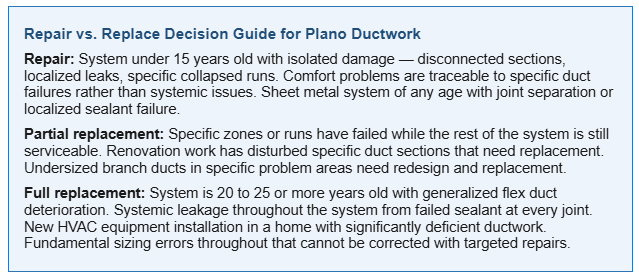
Yes — and in most cases, targeted duct repair is both feasible and cost-effective. Whether repair is the right approach versus full replacement depends on the type of damage, its extent, and the age and overall condition of the duct system. Here is a clear breakdown:
Repairs That Are Straightforward and Highly Effective
Sealing leaking joints, reconnecting separated duct sections, replacing a collapsed or kinked flex duct run, reinsulating a damaged attic duct section, and sealing supply boot connections where the duct meets the register opening at the ceiling or floor are all repairs that can be completed efficiently and produce immediate, measurable improvements in system performance. These targeted repairs address specific failure points without requiring the cost and disruption of a full duct system replacement.
When Repair Makes Clear Sense
- Isolated damage: A single disconnected flex duct run, a leaking joint at a specific location, or a crushed section that developed from attic storage placed on the duct — these are specific, addressable problems.
- Newer duct system with localized issues: A duct system less than 15 years old with otherwise sound construction and good insulation is typically worth repairing when specific damage is found, rather than replacing the full system.
- Post-renovation reconnection: When remodeling work has disturbed duct connections or required duct sections to be cut and relocated, repair and reconnection of the affected sections restores full system performance.
When Repair Transitions to Replacement
Some situations call for partial or full duct system replacement rather than targeted repair:
- Generalized flex duct deterioration: When flex duct throughout the system is brittle, collapsing, or showing widespread inner liner breakdown — a condition common in systems 20 to 25 or more years old — patching individual sections produces diminishing returns as additional sections fail over subsequent seasons.
- Systemic leakage from degraded sealant: A duct system where every joint was originally sealed with consumer duct tape may now have effectively no sealing at any connection. The cost of individually resealing every joint approaches the cost of section replacement in many cases.
- Fundamental sizing errors: If the comfort problem results from undersized ducts rather than leakage or damage, repair cannot address the root cause — only redesign and replacement of the undersized sections can correct the airflow imbalance.
If evaluation reveals that the duct system has reached the point where replacement makes more sense than continued repair, our AC duct installation services in Plano, TX page covers our full installation process, including Manual D design and post-installation airflow verification.
What Is the Lifespan of AC Ductwork in Plano, TX?
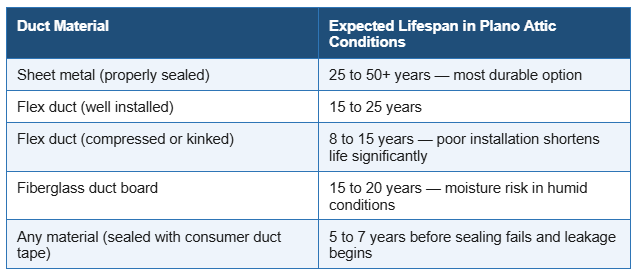
The service life of ductwork varies significantly by material type, installation quality, and the operating environment. Plano's attic conditions — sustained temperatures of 140 to 160 degrees during summer — are among the most demanding for duct materials in the country. Here is a realistic assessment of what each duct type delivers in this climate:
Sheet Metal Ductwork: 25 to 50+ Years
Galvanized sheet metal is the most durable duct material available. It does not degrade from heat cycling, does not support biological growth when kept dry, and maintains its dimensions and airflow capacity indefinitely. Sheet metal ductwork from the 1970s and 1980s is still in active service in Plano homes today. Its primary failure mode is joint separation from building settlement over decades — addressable with targeted resealing rather than replacement. The higher upfront cost is paid back many times over in longevity.
Flexible Duct: 15 to 25 Years
Modern flexible duct — the corrugated plastic and foil tube system used for branch duct runs in most residential construction since the 1990s — has a service life of 15 to 25 years under good installation conditions. In Plano attics, the inner plastic liner becomes brittle from repeated heat cycling, the foil outer jacket degrades, and the spiral wire support can separate, allowing the inner liner to collapse and block airflow. Flex duct that was installed with excessive length, sharp bends, or tight compression degrades significantly faster than properly installed runs. Many Plano homes built in the 1990s and early 2000s are at or approaching this threshold.
Fiberglass Duct Board: 15 to 20 Years
Rigid fiberglass duct board provides good insulation value integrated into the duct wall but is susceptible to moisture damage in Plano's humid spring and summer conditions. The interior fiberglass surface can deteriorate over time and shed fibers into the airstream. Duct board systems that have experienced any moisture infiltration — from condensation inside the duct or from roof leaks — can develop mold growth on the fiberglass substrate. Systems over 20 years old warrant careful inspection of the duct board condition at accessible locations.
The Impact of Installation Quality on Lifespan
Material lifespan assumes proper installation. A flex duct run that was installed compressed, sharply bent, or with excessive unsupported length may fail functionally within 8 to 12 years even if the material itself would have lasted 20. A sheet metal duct system with poorly fitting joints and consumer duct tape sealing will have significant leakage within 5 to 7 years as the tape adhesive fails in the attic heat. Installation quality is as important as material selection in determining how long a duct system actually performs.
How Often Do You Need to Replace HVAC Ductwork in Plano, TX?
There is no fixed replacement schedule for ductwork — the right time to replace depends on material type, installation quality, current condition, and whether the existing system is producing performance problems. Here is a practical framework for evaluating when replacement makes sense:
The Age and Material Threshold
For homes with original flex duct that is 20 to 25 years old, duct replacement is worth serious evaluation during any major HVAC system service. The inner liner has typically undergone significant heat cycling by this point, and individual section failures tend to accelerate as the material reaches end of life simultaneously throughout the system. Replacing aging flex duct proactively — rather than reactively when failures produce comfort complaints — avoids the disruption and temporary system downtime of emergency repairs.
Sheet metal systems do not have a meaningful replacement threshold based on age alone. The question is condition — inspecting accessible connections and joints every decade or so, and resealing where sealant has dried and cracked, keeps a metal duct system serviceable for the life of the building.
The Performance Threshold
Regardless of age, a duct system that is producing measurable comfort problems despite a functioning HVAC system should be evaluated for repair or replacement. The diagnostic question is whether the problems are caused by specific repairable failures or by systemic issues that would require more than targeted repairs to correct. A duct leakage test that measures total system leakage can quantify how much conditioned air is being lost and help determine whether repair addresses the majority of the problem.
The Equipment Replacement Trigger
When an HVAC system is replaced, the duct system should always be evaluated as part of the project. A new high-efficiency system installed in significantly leaking ductwork will never deliver the efficiency or comfort its ratings promise. The marginal cost of addressing duct deficiencies at the same time as equipment replacement is almost always less than the cost of a separate duct project later — and the homeowner gets the full benefit of the new equipment from day one rather than discovering performance gaps afterward.
Common AC Duct Problems We Repair in Plano, TX Homes
Leaking Joint and Connection Seals
Every joint and connection in a duct system is a potential leak point. In systems where connections were originally sealed with consumer duct tape, the tape adhesive typically fails in attic heat within three to seven years, leaving gaps at every joint it was applied to. We reseal leaking connections using mastic sealant — a durable water-based adhesive compound that withstands attic temperature cycling — or UL-listed metal foil tape on metal duct surfaces. Professional resealing of a leaking duct system can reduce energy losses by 15 to 25 percent in homes with significant prior leakage.
Disconnected Flex Duct Sections
Flex duct connections at the trunk line takeoff and at the supply boot can separate from vibration, from the flex duct weight pulling against the connection over time, or from disturbance during attic access for other maintenance. A disconnected flex duct run delivers all of its conditioned air directly into the attic rather than to the room it serves — producing dramatic room temperature problems that are often misdiagnosed as equipment failures. Reconnecting and properly securing a disconnected flex duct run corrects the problem immediately.
Collapsed and Kinked Flex Duct
Flex duct that has been compressed under stored items, kinked around a sharp corner, or left unsupported across a long span can collapse or kink in ways that severely restrict or block airflow. Unlike a leak, a collapsed duct sends no air to the room it serves — the room effectively has no supply air. Replacement of the damaged section with properly supported and routed flex duct restores full airflow.
Supply Boot Seal Failures
The supply boot is the metal fitting that connects the flex duct to the register opening at the ceiling or floor. Gaps between the boot and the drywall or subfloor — from settling, poor original installation, or drywall work — allow conditioned air to escape into the wall cavity or attic space rather than entering the room. These leaks are often close to the conditioned space and therefore particularly wasteful. Sealing supply boots with mastic or metal tape is one of the highest return-on-investment duct repairs available.
Insulation Damage on Attic Ductwork
Flex duct insulation jackets can be torn by pests, degraded by UV exposure if accessible, or compressed flat by foot traffic in the attic. Damaged insulation on attic ductwork in Plano's 140-degree summer attics allows significant heat gain into the conditioned air before it reaches the register. Replacing damaged insulation sections or wrapping exposed duct with appropriate insulation restores the system's efficiency.
Return Air Leaks and Restrictions
Return air problems — leaks in return duct runs or insufficient return air capacity — create negative pressure in the air handler that affects the entire system's performance. Return duct leaks pull unconditioned attic air directly into the air handler, bypassing the filter and introducing heat, dust, and humidity. Undersized return ducts restrict the system's airflow and force elevated static pressure on the blower motor. Both are diagnosable with airflow measurement and static pressure testing.
How DT Air Conditioning & Heating Approaches AC Duct Repair in Plano, TX
Every duct repair begins with evaluation, not assumptions. Here is what our process looks like:
- System performance assessment. We measure airflow at each supply register, check static pressure at the air handler, and identify which rooms are underperforming compared to their expected airflow based on the system's total output.
- Accessible duct inspection. We inspect accessible duct sections in the attic, crawl space, and mechanical areas for visible disconnections, collapsed sections, insulation damage, and seal failures.
- Leak source identification. For systems with measured leakage that exceeds acceptable limits, we identify the primary leak locations using airflow measurement and, where appropriate, pressure testing to quantify total system leakage.
- Written findings and repair options. We document what we found and provide written repair options — targeted repair, partial section replacement, or full system evaluation referral — with pricing before any work begins.
- Professional repair execution. All sealing work uses mastic sealant or UL-listed metal foil tape. No consumer duct tape. Reconnected and replaced flex duct sections are properly supported and routed. Insulation repairs match the original R-value specification.
- Post-repair airflow verification. After completing repairs, we remeasure airflow at affected registers and verify that the system's static pressure has returned to an acceptable range. We confirm the performance improvement before closing the job.
Related AC Services in Plano, TX
AC Duct Installation
When evaluation reveals that the duct system has deteriorated past the point where targeted repair delivers the best value, our AC duct installation services in Plano, TX cover the full replacement process including Manual D design, professional fabrication and installation, and post-installation airflow verification.
AC Parts Repair
Duct problems that have forced the system to operate against elevated static pressure for an extended period can cause secondary blower motor wear and accelerated component deterioration. Our AC parts repair services in Plano, TX address the component-level repairs that sometimes accompany longstanding duct system deficiencies.
AC Compressor Repair
A duct system that has caused the AC to run continuously under elevated static pressure for multiple seasons may have contributed to compressor stress. Our AC compressor repair services in Plano, TX cover how we evaluate compressor health in the context of duct-related system stress.
AC Condenser Repair
For systems where airflow restriction has caused the outdoor unit to operate under stress, our AC condenser repair services in Plano, TX cover condenser evaluation and repair as part of a comprehensive system assessment.
Why Plano Homeowners Choose DT Air Conditioning & Heating for AC Duct Repair
Duct repair is frequently undersold or misdirected in the HVAC market — homeowners are steered toward equipment replacement when duct repair would solve the comfort problem at a fraction of the cost, or given temporary tape fixes that fail within a few years. Here is what makes our approach different:
- We measure before we recommend — airflow testing and static pressure measurement identify the actual problem before any repair is suggested
- All sealing work uses mastic sealant or UL-listed metal foil tape — never consumer duct tape that will fail in the attic heat
- Written estimates before any repair work begins with clear explanation of what was found and why the repair addresses it
- Post-repair airflow verification confirms the repair actually improved system performance
- Honest guidance on when repair is the right answer and when replacement makes more sense
- Licensed and insured technicians on every call — no subcontracting
- Same-day service available when a duct failure has left a room without cooling in the middle of summer
Call us at 972-633-9343, visit us at 6713 Oceanview Drive, Plano TX 75074, or schedule your duct evaluation at www.dt-ac.com/contact.



Frequently Asked Questions: AC Duct Repair in Plano, TX
How much does AC duct repair cost in Plano?
Duct repair costs depend on the type and extent of the repairs needed. Sealing leaking connections and supply boots is at the lower end of the cost range. Replacing collapsed or disconnected flex duct sections is mid-range. Comprehensive resealing of an entire duct system or partial duct replacement involves more materials and labor. We provide a written estimate covering all recommended repairs after the diagnostic evaluation — you always know what you are approving before any work begins.
Can I seal duct leaks myself?
Accessible duct connections that are reachable from the attic or a crawl space can be sealed by a careful homeowner using the correct materials — mastic sealant applied with a brush, or UL-listed metal foil tape on metal surfaces. Consumer duct tape is not appropriate for HVAC ductwork and should not be used. The practical limitation is access: most duct connections in a finished home are either in the attic, inside walls, or under the floor — locations that require physical access and appropriate safety precautions to reach. For any duct work that requires disconnecting or replacing sections, professional service is the appropriate choice.
How do I know if my ducts are leaking?
The most reliable indicators of duct leakage are rooms that consistently underperform despite the AC running, energy bills that are higher than expected or have risen without a change in usage, musty or dusty odors from supply registers, and an AC system that runs almost constantly without reaching set temperature. Professional duct leakage testing using blower door equipment or duct pressurization can quantify total system leakage precisely and identify where the leaks are concentrated.
Will duct repairs lower my energy bills?
In homes with significant duct leakage — which the DOE estimates describes the majority of existing homes — professional duct sealing typically reduces cooling and heating energy consumption by 15 to 25 percent. In homes with severe leakage, the improvement can be greater. The payback period for duct repair depends on energy costs and the severity of the prior leakage, but in Plano's long cooling season, most duct repair investments pay for themselves within two to four cooling seasons.
Does duct repair require a permit in Plano, TX?
Targeted repairs to existing ductwork — sealing leaks, reconnecting separated sections, replacing collapsed flex duct runs — generally do not require a permit. Significant duct system modifications, including adding new duct runs or substantially changing the duct system layout, typically do require a mechanical permit from the City of Plano. We confirm permitting requirements for each project before work begins.
What is the difference between duct repair and duct cleaning?
Duct repair addresses structural problems in the duct system — leaks, disconnections, collapsed sections, and insulation failures — that affect airflow and energy efficiency. Duct cleaning removes accumulated dust, debris, and biological contamination from the interior surfaces of the ducts. The two services address different problems and are not interchangeable. Duct repair improves how much conditioned air reaches its destination; duct cleaning improves the cleanliness of the air that travels through the system. We evaluate whether either or both are indicated based on system condition.