
%20(2).svg)

AC Motor Repair in Plano, TX
AC Motor Repair in Plano, TX: Diagnose the Right Motor, Fix It Right the First Time
Your home's air conditioning system relies on multiple electric motors to move air and reject heat — and when any one of them fails, the symptoms can look deceptively similar to a refrigerant problem, a failing compressor, or a thermostat issue. Knowing which motor has failed, why it failed, and whether the right repair is a capacitor, a full motor replacement, or something else entirely requires proper diagnostic equipment and technical training. At DT Air Conditioning & Heating, our AC motor repair in Plano, TX starts with identifying exactly which motor is the problem and why — so the repair we perform is the one that actually resolves it.
This guide covers the motors in your AC system, how to recognize when each is failing, whether AC motors can be repaired or only replaced, how long they should last in Plano's demanding climate, and what causes them to fail prematurely.
What Is AC Motor Repair in Plano, TX?
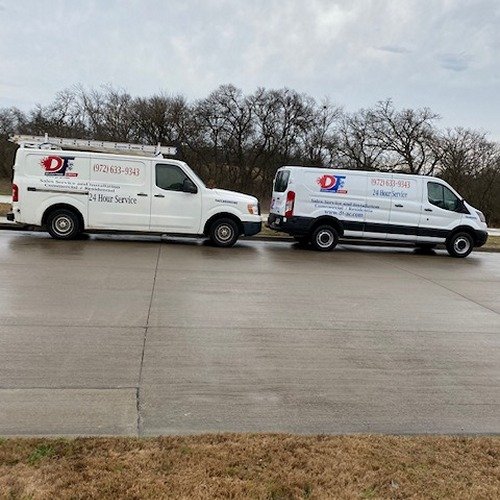
AC motor repair in Plano, TX covers the diagnosis and repair or replacement of the electric motors within a residential air conditioning system. A standard central AC system contains two primary motors: the indoor blower motor that moves conditioned air through the ductwork and the outdoor condenser fan motor that pulls air across the condenser coil to reject heat. Both motors are supported by run capacitors that assist in starting and sustaining motor operation. Common AC motor repairs include run capacitor replacement when the capacitor has degraded below rated specification, blower motor replacement when the motor windings or bearings have failed, and condenser fan motor replacement. DT Air Conditioning & Heating diagnoses motor failures with calibrated instruments, provides written estimates, and carries commonly needed replacement motors on service vehicles for same-visit completion of most motor repairs.
The Motors in Your Home's AC System and What Each One Does
Understanding the two primary motors in a residential AC system explains why each failure produces different symptoms — and why correct diagnosis before replacement matters.
The Indoor Blower Motor
The blower motor is located inside the air handler or furnace and is responsible for circulating air through your home. It draws return air from the rooms of the house through the return air grilles, passes it across the evaporator coil where cooling and dehumidification occur, and then pushes the conditioned air through the supply ductwork to every room in the house. The blower motor runs every time the system is in cooling or heating mode, and in many homes it also runs when the thermostat is set to FAN ON for continuous air circulation.
Most residential blower motors are single-phase PSC (permanent split capacitor) motors in standard efficiency systems, or variable-speed ECM (electronically commutated motor) motors in higher-efficiency systems. ECM motors are significantly more energy efficient and quieter but carry higher replacement costs due to the motor and control module combination.
The Outdoor Condenser Fan Motor
The condenser fan motor is mounted in the outdoor unit and drives the large fan blade that pulls ambient air upward through the condenser coil. This airflow is what allows the refrigerant in the condenser coil to release its heat to the outdoor air. When the condenser fan motor fails, the outdoor unit may appear to be running — the compressor is operating and making noise — but without the fan moving air across the coil, heat cannot be rejected. The refrigerant temperature and pressure climbs until the system trips a high-pressure safety limit and shuts down.
In Plano's long cooling seasons, the outdoor condenser fan motor runs for thousands of hours per year, fully exposed to Texas summer heat. It is one of the highest-wear components in the system.
The Run Capacitor — Not a Motor, But Critical to Both
The run capacitor is not a motor itself but is functionally part of both the compressor circuit and the condenser fan motor circuit. It is a cylindrical or oval electrical component that stores and releases an electrical charge to assist in starting and sustaining motor operation. A capacitor that has degraded — losing capacitance over time from heat exposure — causes the motor to work harder than it was designed to on every startup cycle. This creates the characteristic hard-start symptom: the motor hums and struggles to begin rotation rather than starting smoothly. A failed capacitor is the most common cause of what homeowners describe as a motor problem, and capacitor replacement is the most cost-effective motor-related repair available.


Signs Your AC Motor Is Failing in Plano, TX
Motor problems rarely announce themselves with complete, immediate failure. Most develop gradually through recognizable warning signs that, caught early, allow a repair visit rather than an emergency call.
Signs of a Failing Blower Motor
- Weak or absent airflow from supply registers despite the outdoor unit running normally
- A humming sound from the air handler that does not progress to the blower starting and moving air
- Airflow that is noticeably reduced compared to previous cooling seasons without a change in the filter
- A burning smell from the air handler vents — a sign of motor winding insulation breaking down from heat
- The air handler starts and stops repeatedly in short cycles as the motor attempts to start and trips its thermal overload
- The indoor air handler makes a grinding or squealing sound during operation — indicating bearing wear
- On variable-speed systems, the air handler runs at only one speed regardless of what the thermostat requests
Signs of a Failing Condenser Fan Motor
- The outdoor unit is running — the compressor is making noise — but the fan blade on top of the outdoor unit is not spinning
- The fan blade spins slowly or erratically rather than at full speed
- The system starts, runs briefly, then shuts off on its own — the high-pressure limit is tripping because heat is not being rejected without the fan running
- A grinding, screeching, or rattling sound from the outdoor unit when the system is running
- The outdoor unit fan blade wobbles during operation, indicating a motor shaft or blade mounting problem
- The outdoor unit and surrounding area feel significantly hotter than usual during operation, indicating reduced heat rejection
Signs the Problem Is the Capacitor Rather Than the Motor
Because a failed capacitor produces motor symptoms, distinguishing between a capacitor problem and a true motor failure is one of the most important diagnostic steps in AC motor repair. A capacitor problem is significantly less expensive to repair than a motor replacement, and misdiagnosing a capacitor failure as motor failure costs the homeowner the difference unnecessarily.
- The motor hums but does not start — this is the classic capacitor failure symptom. The motor has power but cannot develop enough starting torque without the capacitor's boost
- The motor starts when given a gentle push by hand (for an outdoor fan motor) — this confirms the motor is mechanically sound but the capacitor is not providing starting assistance
- The system has been working intermittently — starting some cycles and failing to start others — as a degrading capacitor produces inconsistent results near end of life
- The capacitor measures significantly below its rated microfarad value on a capacitance meter — this is the definitive diagnostic confirmation
Can an AC Motor Be Repaired in Plano, TX?
The answer depends on the specific type of motor and the nature of the failure. The honest distinction in residential HVAC is this: most residential AC motor failures result in motor replacement rather than motor repair, with capacitor replacement being the important exception.
Capacitor Replacement — The Most Common and Most Effective Motor Repair
When a capacitor has degraded or failed — which accounts for a significant percentage of all motor-related service calls — replacing the capacitor is a genuine repair that restores motor function without replacing the motor itself. A capacitor that reads below specification on a calibrated capacitance meter is replaced with a correctly rated new capacitor, and in most cases the motor resumes normal operation immediately. This is the most cost-effective outcome for any motor-related complaint and is the correct first step in any motor diagnostic process.
Hard-Start Kit Installation
For motors that are showing early signs of hard starting — laboring to begin rotation, drawing elevated starting current — a hard-start kit provides additional starting capacitance and a potential relay that reduces the electrical stress of each startup cycle. A hard-start kit extends the functional life of a motor that is beginning to show wear and reduces the thermal and electrical stress on the motor windings and compressor on each startup. It is not a repair for a motor that has already failed mechanically, but it is a valuable intervention for one that is weakening.
Motor Replacement — The Standard Resolution for Motor Mechanical Failure
When the motor itself has failed — bearing seizing, winding burnout, shaft damage, or insulation breakdown — replacement is the standard resolution for residential applications. Unlike industrial motors that are large enough to justify rewinding and refurbishment, residential HVAC motors are typically replaced as complete assemblies. The replacement motor is matched to the original specifications — horsepower, RPM, frame size, rotation direction, and voltage — and installed with the same electrical connections and mechanical mounting as the failed unit.
Standard PSC blower motors and condenser fan motors are widely stocked and available for same-visit replacement in most cases. ECM variable-speed motors and their control modules are more specialized and may require ordering, particularly for less common system models.
When Motor Repair Points Toward Broader Evaluation
A motor failure on a system that is approaching end of life raises the same repair-versus-replace question as any major component failure. The $5,000 rule applies: multiply the system age by the motor repair cost, and if the result exceeds $5,000, full system replacement deserves serious evaluation alongside the motor repair option.
If the motor failure is part of a broader pattern of component wear on an aging system, our AC replacement services in Plano, TX page covers the full replacement process including system selection, load calculation, and installation.
What Is the Lifespan of an AC Motor in Plano, TX?
Motor lifespan varies by motor type, operating environment, and whether the motor's capacitor is maintained proactively. In Plano's climate, where the cooling system runs at high demand for five to six months per year, the motors accumulate more annual operating hours than the same motors in milder climates.
Condenser Fan Motor: 8 to 15 Years
The outdoor condenser fan motor is fully exposed to Plano's summer heat while running continuously during system operation. Bearing wear from sustained high-temperature operation, insulation degradation from heat cycling, and capacitor-induced hard-start stress are the most common failure modes. Proactive capacitor replacement when the capacitor measures below specification — typically performed during annual maintenance — is the single most effective way to extend condenser fan motor life by eliminating hard-start stress. Motors maintained this way consistently reach the upper end of the 8-to-15-year range.
Blower Motor (Standard PSC): 10 to 20 Years
The indoor blower motor operates in a more temperature-controlled environment than the outdoor fan motor but runs for more hours per year in most systems, since it operates during both heating and cooling modes. Bearing wear, winding insulation breakdown from sustained operation, and capacitor degradation are the primary failure modes. Standard blower motors are relatively robust and, with proper capacitor maintenance, frequently reach 15 or more years of service life.
Blower Motor (Variable-Speed ECM): 10 to 20 Years
ECM variable-speed motors run at much lower continuous loads than standard motors because they modulate their speed to match the system's actual airflow demand rather than running at full capacity whenever they run. This reduced thermal and electrical stress means ECM motors are inherently gentler on their windings and bearings. However, the control module that drives the ECM motor is an electronic component that can fail independently of the motor itself, and ECM system failures sometimes involve replacing the control module rather than or in addition to the motor assembly.
Run Capacitor: 5 to 10 Years
Run capacitors are the shortest-lived component in the motor circuit. In Plano's long cooling seasons and high attic temperatures — where the outdoor unit capacitor is exposed to temperatures inside the outdoor unit cabinet that exceed the air temperature significantly — a capacitor that might last 8 to 10 years in a cooler climate often reaches end of useful specification in 5 to 7 years. Annual capacitor testing during maintenance visits, with proactive replacement when measured capacitance drops more than 5 to 10 percent below the nameplate rating, prevents the majority of motor-related service calls.
AC Motor Component
Expected Lifespan in Plano, TX
Condenser fan motor
8 to 15 years — heat exposure and capacitor health are key variables
Blower motor (standard PSC)
10 to 20 years — more protected environment, longer range
Blower motor (ECM variable-speed)
10 to 20 years — lower thermal stress; control module may fail separately
Run capacitor (outdoor)
5 to 10 years — Plano heat accelerates degradation toward lower end
Run capacitor (indoor)
7 to 12 years — more protected but still degrades with time
Hard-start kit
8 to 15 years — reduces startup stress on compressor and fan motor
What Are Common Causes of AC Motor Failure in Plano, TX?
Most AC motor failures in Plano homes are not random — they result from specific, identifiable causes that are often preventable with proper maintenance. Understanding the most common failure causes helps homeowners make maintenance decisions that extend motor life and avoid emergency service calls.
Capacitor Failure Causing Hard-Start Stress
This is the leading cause of premature motor failure in residential AC systems. A run capacitor that has degraded — which happens gradually from heat exposure over years of operation — no longer provides the motor with adequate starting and running assistance. The motor must work harder to start on each cooling cycle, drawing more current than its rated full-load amps and generating more heat in the windings on every startup. Over time, this repeated hard-start stress damages the motor winding insulation and accelerates bearing wear. The motor that eventually fails was often killed by a capacitor that was never replaced when it measured below specification.
Bearing Wear from Age and Operating Hours
Electric motors contain bearings that support the rotor shaft and allow smooth, low-friction rotation. These bearings wear gradually with operating hours, and the rate of wear is accelerated by any condition that increases load or heat on the bearing — including a degraded capacitor, a dirty condenser coil increasing the thermal load on the outdoor motor, restricted airflow increasing the blower motor's workload, or simple accumulation of operating hours over many cooling seasons. Bearing failure typically produces a grinding or screeching sound before complete motor seizure.
Heat Overload from Environmental Conditions
The outdoor condenser fan motor operates in one of the most thermally demanding environments of any residential mechanical component. Ambient temperatures of 100 degrees or more, combined with the heat generated inside the outdoor unit cabinet itself, expose the motor to sustained high temperatures that accelerate insulation breakdown and bearing grease degradation. Maintaining the condenser coil in a clean condition — so the system is not running at elevated head pressure, which increases overall unit temperature — reduces the thermal load on the outdoor fan motor and extends its service life.
Moisture and Contaminant Intrusion
Outdoor condenser fan motors are exposed to rain, humidity, cottonwood, grass clippings, and debris. While most motors have some degree of weather protection, sustained moisture exposure — particularly around the motor shaft seal and bearing housings — can accelerate corrosion and bearing degradation. Keeping vegetation and debris cleared from around the outdoor unit and ensuring the condenser coil is clean are the practical homeowner contributions to protecting the outdoor motor from contaminant-related wear.
Electrical Supply Problems
Voltage imbalance, low voltage from the utility supply, and power surges all stress motor windings and can cause overheating or insulation failure over time. Motors are designed to operate within a defined voltage range; sustained operation at voltages below or above that range causes the motor to draw more current than rated, generating excess heat. A surge protector for the outdoor unit and a whole-home surge protection device provide meaningful protection against transient voltage events that can damage motor windings and control modules.
Dirty Air Filters Overloading the Blower Motor
A severely clogged air filter restricts the airflow the blower motor must move against — effectively increasing the load on the motor. This causes the blower to draw more current than its design rating, generate more heat in the windings, and in sustained cases cause the motor's thermal overload protector to trip. Repeated overload tripping accelerates insulation wear and shortens motor life. Filter replacement every one to three months during the cooling season is the most direct homeowner action for protecting the blower motor.
How DT Air Conditioning & Heating Diagnoses AC Motor Problems in Plano, TX
Motor diagnosis requires measurement, not guesswork. Here is what our technicians do on every motor-related service call:
- Capacitor testing first. Before any motor replacement is recommended, we test the run capacitor against its rated microfarad specification using a capacitance meter. A capacitor measuring more than 5 to 10 percent below its rated value is replaced first. In many cases this resolves the motor complaint entirely.
- Motor amp draw measurement. We measure the motor's operating current against its rated full-load amps. Elevated amp draw confirms the motor is working harder than designed — from bearing wear, winding problems, or overload conditions. Low or no amp draw confirms the motor is not receiving power or has an open winding.
- Voltage verification. We verify that the motor is receiving correct supply voltage and that voltage is present at the motor terminals. A motor that appears to have failed may simply have a failed contactor or a wiring fault that is interrupting power supply.
- Physical inspection. We inspect the motor for visible signs of overheating — discoloration, burnt insulation smell, melted components — and test shaft rotation by hand for bearing binding or roughness.
- Winding resistance test. For motors that are confirmed to have failed, we measure winding resistance to distinguish between an open winding, a shorted winding, and a winding-to-ground fault. This confirms that motor replacement is required and helps identify whether the failure was from overload, moisture, or age-related insulation breakdown.
- Written estimate before any replacement work. After completing the diagnostic, we provide the part cost, labor cost, and total repair cost in writing before any motor replacement begins. We also provide the system-age calculation for the $5,000 rule if the system is 8 or more years old, so you have the full context for the decision.
The Connection Between AC Motor Health and Annual Maintenance in Plano, TX
The most consistent finding in AC motor failures is that they were preventable. A capacitor that failed and caused a motor to hard-start itself into early burnout would have been identified as below-specification during an annual maintenance visit. A condenser fan motor that overheated from operating against a dirty condenser coil would have been protected by the coil cleaning performed during that same visit. A blower motor that burned out from chronic operation against a clogged filter would have been identified at the first maintenance visit after the filter was due for replacement.
Annual professional maintenance that includes capacitor testing, motor amp draw measurement, coil cleaning, and filter inspection catches the conditions that cause motor failures before those conditions become failures. The cost of an annual maintenance visit is a small fraction of the cost of a motor replacement — and it protects the motor from the preventable failures that shortened its life.
Explore our AC maintenance plans in Plano, TX to find the right maintenance schedule for protecting your system's motors and all other components through Plano's demanding cooling seasons.
Related AC Services in Plano, TX
For component-level AC repairs beyond motor work — including capacitors, contactors, control boards, and refrigerant system components — see our AC parts repair services in Plano, TX, which covers the full scope of what we evaluate and repair on a standard diagnostic service call.
For systems where a motor failure is part of a pattern of aging component failures that makes replacement the more practical choice, our AC replacement services in Plano, TX page covers the full replacement process from system selection through professional installation.
Why Plano Homeowners Choose DT Air Conditioning & Heating for AC Motor Repair
Motor repair is one of the areas where the diagnostic discipline of the technician matters most — because the difference between a $75 capacitor replacement and a $400 motor replacement often comes down to whether the capacitor was properly tested before the motor replacement was recommended. Here is what our approach delivers:
- Capacitor testing before any motor replacement recommendation — the most common motor complaint is resolved by the least expensive repair
- Calibrated amp draw testing and winding resistance testing to confirm motor failure before replacement is authorized
- Written estimates with full pricing before any motor replacement work begins
- Stocked replacement motors for common residential brands and sizes on service vehicles for same-visit completion
- Licensed and insured technicians on every call — no subcontracting
- Honest system-age evaluation: we will tell you when a motor replacement makes sense and when the $5,000 rule suggests a broader system replacement conversation
- Same-day and emergency service when a motor failure has shut down your AC in the middle of a Plano summer
Call us at 972-633-9343, visit us at 6713 Oceanview Drive, Plano TX 75074, or schedule your motor diagnostic at www.dt-ac.com/contact.
Frequently Asked Questions: AC Motor Repair in Plano, TX
How do I know if my AC motor is bad or if it is the capacitor?
You cannot reliably distinguish these without a capacitance meter and amp draw measurement. The symptom — motor won't start, hums without turning — is identical for both. Our technicians test the capacitor first, every time, before any motor replacement is recommended. A capacitor that tests at specification redirects the diagnosis to the motor. One that tests below specification is replaced first.
Can I replace an AC motor myself?
Capacitor replacement by an experienced homeowner who understands the safety requirement of discharging the capacitor before handling is possible with careful research and proper precautions. Motor replacement involves electrical work at the air handler or outdoor unit that requires disconnecting line voltage, matching motor specifications precisely, and reconnecting motor wiring correctly. Errors in motor specification matching — getting the horsepower, RPM, rotation direction, or voltage wrong — can damage the new motor immediately. For most homeowners, motor replacement is a professional service call.
How long does an AC motor replacement take?
A standard condenser fan motor or blower motor replacement, including diagnostic confirmation, parts retrieval from the service vehicle, motor swap, and operational verification, typically takes one to two hours for a motor that is in stock. ECM variable-speed motor replacements may take longer due to the additional control module components and calibration steps some systems require.
What brands of motors do you carry and install?
We carry replacement motors compatible with all major residential AC brands including Carrier, Trane, Lennox, Rheem, Goodman, American Standard, and others. For systems requiring an OEM-specific motor, we can typically source and install the correct part within one to two business days. We match motor specifications — horsepower, RPM, frame, and voltage — precisely to the original to ensure correct system performance.
My condenser fan was spinning slowly before it stopped. What does that mean?
Slow fan operation before complete failure is a classic indicator of a capacitor that has degraded to the point where it can sustain motor operation at reduced capacity but can no longer support full-speed operation. It can also indicate a failing bearing that is creating drag. Both conditions are diagnosable with amp draw and capacitance testing. If the fan was noticeably slower than normal for several weeks before it stopped, the capacitor is the most likely primary cause.
Does a motor replacement affect my manufacturer warranty?
Motor replacements performed by a licensed HVAC contractor using appropriate replacement parts typically do not void manufacturer warranties on other system components. For systems still within the original manufacturer warranty period, certain motor failures may be covered under that warranty — check your documentation and contact us with your system model and serial number to determine whether warranty coverage applies before authorizing an out-of-pocket repair