
%20(2).svg)

AC Compressor Repair in Plano, TX
Accurate Diagnosis Before Any Major Decision
The AC compressor is the single most important and most expensive component in your home's air conditioning system. When it fails — or when a technician suspects it is failing — you are facing one of the biggest decisions in residential HVAC: repair the compressor, replace the full system, or accept a diagnosis that may not have been thorough enough to be reliable. At DT Air Conditioning & Heating, our approach to AC compressor service in Plano, TX starts with the diagnostic work that makes the repair-versus-replace decision a confident one, not a guess.
Whether your system has stopped cooling entirely, is struggling to reach set temperature, or a previous technician has told you the compressor has failed, this guide covers what the compressor does, how to recognize when it is failing, how long it should last, whether repair or replacement makes financial sense, and what the honest evaluation process looks like from a qualified HVAC technician.



What Is AC Compressor Service in Plano, TX?
AC compressor service in Plano, TX includes professional diagnosis of compressor condition through pressure testing, amp draw measurement, electrical testing, and operational evaluation; hard-start kit installation to reduce compressor startup stress; compressor replacement when diagnosis confirms failure; and full system evaluation to identify the root cause of compressor failure before replacement is completed. DT Air Conditioning & Heating provides written estimates before any compressor work begins, performs refrigerant recovery and recharge as part of every compressor replacement, and gives honest guidance on whether repair or full system replacement is the more appropriate path based on the system's age, condition, and warranty status.
What Your AC Compressor Does and Why It Matters So Much
Understanding what the compressor does explains why its failure stops the cooling process entirely and why its replacement is the most expensive single repair in a residential AC system.
The compressor is the mechanical pump at the heart of your AC's refrigerant circuit. It draws in low-pressure refrigerant vapor from the indoor evaporator coil and compresses it into high-pressure, high-temperature vapor. That high-pressure vapor flows to the outdoor condenser coil, where it releases its heat to the outdoor air and condenses back into liquid. The liquid refrigerant then flows through the metering device into the evaporator coil, where it expands, absorbs heat from indoor air, and becomes vapor again — completing the cycle.
Without a functioning compressor, refrigerant cannot circulate and no heat transfer occurs. The system may blow air, but it will not cool. This is why compressor failure produces the specific symptom of a system that runs but delivers only warm or room-temperature air from the supply registers.
The compressor is also the most mechanically stressed component in the system. It runs under high pressure and high temperature every minute the AC operates, and Plano's five-to-six-month cooling season means it accumulates more annual operating hours than compressors in milder climates. Every factor that forces the compressor to work harder than it was designed to — dirty condenser coils, low refrigerant charge, incorrect refrigerant charge, restricted airflow — shortens its service life.
What Are the Signs of a Weak AC Compressor in Plano, TX?
Compressor problems rarely appear without warning. Recognizing the early signs gives you time to address contributing factors — like a low refrigerant charge or dirty condenser coil — before they produce complete compressor failure. Here are the most reliable indicators that your compressor is struggling:
The System Runs But Produces Warm or Slightly Cool Air
This is the most common functional sign of a compressor that is weakening or has failed. A compressor that is not pressurizing refrigerant effectively cannot drive the refrigerant through the heat exchange cycle. The system blows air and the outdoor unit runs, but the temperature differential between supply and return air is minimal or absent. This symptom overlaps with low refrigerant from a leak, which is why measurement-based diagnosis is essential before assuming compressor failure.
Hard Starting — The System Struggles or Fails to Start
A compressor that is beginning to fail mechanically often has difficulty starting against the system's refrigerant pressure, particularly during the hottest parts of the day when head pressure is highest. You may hear the outdoor unit attempt to start, hum for a few seconds, and then click off without completing the startup sequence. The system may retry several times before either starting successfully or locking out on thermal protection. This pattern is called hard starting and is a clear indicator that the compressor is under stress. A hard-start kit — a capacitor assembly that provides additional starting torque — can sometimes extend the compressor's functional life while you evaluate your options.
Loud Banging, Clanking, or Rattling From the Outdoor Unit
Internal mechanical damage to the compressor — broken valve reeds, failed pistons, or loose internal components — produces sounds that are distinctly different from the normal operating hum of a healthy compressor. A banging or clanking sound when the outdoor unit starts or runs is one of the most serious warning signs, as it typically indicates internal damage that is progressive. Continuing to run a compressor with audible internal damage risks refrigerant contamination from compressor oil breakdown, which can make subsequent repairs or replacements more complex and expensive.
The Outdoor Unit Trips the Circuit Breaker Repeatedly
A compressor drawing more current than its rated full-load amps — due to internal wear, refrigerant system problems forcing it to work harder, or an electrical fault — will cause the circuit breaker to trip. A breaker that trips once may indicate a transient issue. One that trips repeatedly when the compressor attempts to start is a clear diagnostic signal that requires professional evaluation. Repeatedly resetting a breaker for a struggling compressor risks wiring damage and accelerates the compressor's deterioration.
Suction and Discharge Pressure Readings Outside Normal Range
This is the technician-level diagnostic that distinguishes compressor weakness from other system problems. A healthy compressor maintains a pressure differential between the low-pressure suction side and the high-pressure discharge side that falls within a predictable range for the refrigerant type and operating conditions. A compressor that is losing pumping efficiency shows reduced head pressure and elevated suction pressure — the pressure differential across the compressor is smaller than it should be. This measurement is the most reliable confirmation of compressor condition and is a step that any qualified technician must perform before recommending compressor replacement.
Elevated Compressor Amp Draw
Measuring the compressor's operating amp draw against its rated full-load amps is the electrical equivalent of the pressure differential test. A compressor drawing significantly more current than rated is working harder than it should — typically from internal wear, a refrigerant system problem forcing it to operate outside its design envelope, or an electrical fault. Elevated amp draw accelerates thermal wear and shortens remaining compressor life.
Oil or Refrigerant Residue Around the Compressor
Compressor oil circulates with refrigerant through the system. An oily residue around the compressor body, at refrigerant line connections, or on the base of the outdoor unit indicates a refrigerant-oil leak that is compromising both refrigerant charge and compressor lubrication simultaneously. This is a situation requiring prompt professional attention, as continued operation with reduced lubrication accelerates internal compressor damage.
What Is the Lifespan of an AC Compressor in Plano, TX?
A residential AC compressor has an expected service life of 10 to 15 years under normal operating conditions. In Plano's climate, where the cooling system runs heavily for five to six months per year, realistic expectations for well-maintained systems are 10 to 14 years. Several factors determine where in that range your compressor lands:
Maintenance History — The Biggest Variable
The compressor's service life is more directly affected by how well the rest of the system is maintained than by any characteristic of the compressor itself. A dirty condenser coil forces the compressor to work against elevated head pressure, increasing operating temperature and accelerating wear. Low refrigerant charge from an unaddressed slow leak forces the compressor to run longer and hotter to achieve the same cooling output. A failing capacitor that causes repeated hard starts puts severe mechanical stress on the compressor motor windings and valves with each startup attempt. Systems that receive annual professional maintenance — coil cleaning, refrigerant verification, capacitor testing — consistently produce longer compressor life than those that operate without service.
Refrigerant Charge Accuracy at Installation
A system that was installed with an incorrect refrigerant charge — either overcharged or undercharged — has been operating the compressor outside its designed pressure envelope from day one. Overcharging raises head pressure chronically, forcing the compressor to work harder on every cycle. Undercharging allows the compressor to run hotter and with reduced lubrication, as refrigerant carries lubricating oil throughout the system. Both conditions shorten compressor life measurably compared to a system with a correct factory charge.
Operating Environment and Load Conditions
Plano's sustained summer heat — with temperatures regularly above 100 degrees for weeks at a time — is among the most demanding operating environments for residential AC compressors in the country. A compressor working against ambient temperatures of 105 degrees operates at higher head pressure than the same compressor in a 90-degree environment. This is one reason that the 10-to-15-year national average compressor lifespan should be treated as an optimistic upper bound for Plano systems, particularly those that have operated without consistent maintenance.
Equipment Quality Tier
Builder-grade compressors installed in entry-level systems carry lower quality ratings and shorter rated service lives than the compressors used in mid-grade and premium systems. The brand and model of the system matters, but the quality tier within a brand's product line matters just as much for compressor longevity.
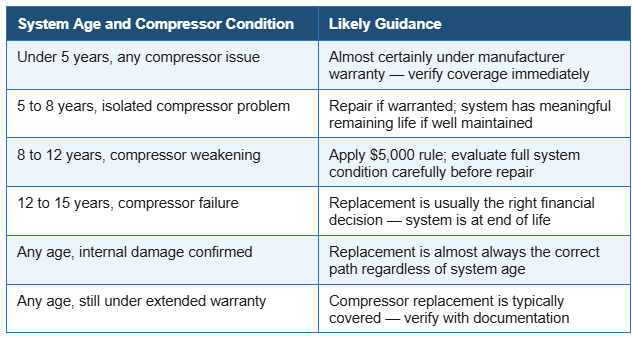
Is It Worth Repairing an AC Compressor in Plano, TX?
This is the question that matters most when a technician has diagnosed compressor failure, and the honest answer depends on several factors that must be evaluated together — not just the repair cost in isolation.
Check Manufacturer Warranty Coverage First
Before any other consideration, verify whether the compressor is still under manufacturer warranty. Most residential AC manufacturers provide a five-year parts warranty as standard, and many offer extended warranties up to 10 years on the compressor when the equipment is registered within the required timeframe after installation. If your system is within the warranty period and has been registered correctly, compressor replacement parts may be covered at little to no cost to you — changing the repair-versus-replace calculus entirely. Locate your warranty documentation and have the model and serial number ready when you call.
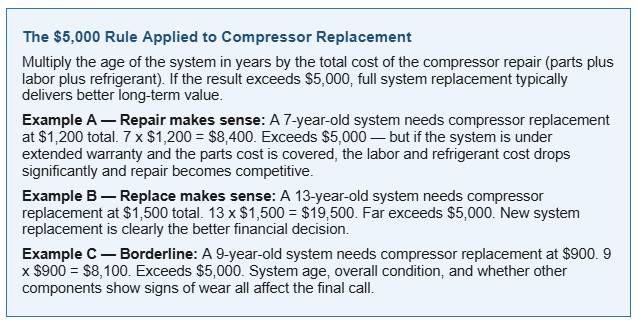
Apply the $5,000 Rule
Evaluate the Root Cause Before Committing to Compressor Replacement
Compressor failure does not happen in isolation. The compressor typically fails because something else in the system — low refrigerant from a leak, dirty coils causing sustained high head pressure, a failing capacitor causing repeated hard starts, or an electrical fault — has been stressing it over time. Replacing the compressor without identifying and correcting the contributing cause means the new compressor will fail under the same conditions. Before authorizing compressor replacement, confirm that your technician has identified and addressed the root cause, not just the presenting failure.
Consider the Contamination Risk
When a compressor fails internally — particularly if it has seized or burned out — it can release compressor oil breakdown products and metal particles into the refrigerant circuit. This contamination can damage the new compressor shortly after installation if the system is not properly flushed. A qualified technician performing compressor replacement will evaluate contamination risk and perform system flushing when indicated. This adds to the repair cost but is a necessary step that protects the replacement compressor.
When Repair Is Clearly the Right Call
- System is under 8 years old with no prior major repairs and good maintenance history
- Compressor is still covered by manufacturer warranty, reducing or eliminating parts cost
- The root cause has been identified and corrected — refrigerant leak repaired, coils cleaned, capacitor replaced
- System has current-refrigerant (R-410A or R-454B) — not R-22, which is expensive and unavailable for future service
- Total repair cost passes the $5,000 rule comfortably
When Replacement Is Clearly the Right Call
- System is 12 or more years old and compressor failure triggers the $5,000 rule
- Internal compressor damage has contaminated the refrigerant circuit — full system replacement avoids repeated contamination risk
- System uses R-22 refrigerant — replacement eliminates ongoing refrigerant supply and cost problems
- Multiple other components are showing wear and the system has had prior repair calls
- Compressor warranty has expired and repair cost approaches new system cost
How DT Air Conditioning & Heating Evaluates AC Compressor Problems in Plano, TX
Compressor diagnosis requires a systematic evaluation that goes beyond listening to the system and feeling the discharge line. Here is how we approach every compressor concern:
- Refrigerant pressure measurement. We connect gauges to the service ports and measure suction and discharge pressure on both sides of the compressor. A compressor with reduced pumping efficiency shows a smaller-than-normal pressure differential. This is the most direct measurement of compressor mechanical condition.
- Compressor amp draw test. We clamp an amp meter on the compressor leads and compare the measured operating current to the rated full-load amps on the nameplate. Elevated amp draw confirms the compressor is working harder than designed. Low amp draw with reduced pressure differential confirms reduced pumping capacity.
- Electrical component testing. We test the run capacitor against its rated microfarad specification and inspect the contactor contacts. A failing capacitor that has been causing hard starts may be the primary problem — and capacitor replacement at a fraction of compressor replacement cost may restore the system to full function.
- Superheat and subcooling measurement. These calculated values verify that the refrigerant charge is correct and that the metering device is functioning properly. A system that appears to have a compressor problem may actually have a refrigerant charge issue or a metering device failure that has been stressing the compressor.
- Visual inspection for contamination indicators. We inspect refrigerant oil condition, look for evidence of burnout, and assess whether internal compressor damage has released contamination into the system.
- Written findings and options before any work is authorized. After completing the diagnostic, we explain exactly what we found, what caused it, and what the options are — repair, compressor replacement, or full system replacement — with pricing for each path before you make any decision.
Related AC Component Services in Plano, TX
A compressor problem rarely exists in isolation. These related services address the components most commonly involved in compressor stress and failure:
AC Parts Repair
For a full overview of component-level diagnosis and repair across all AC parts — capacitors, contactors, blower motors, control boards, and refrigerant system components — see our AC parts repair services in Plano, TX. Understanding the full component picture is essential before committing to any major repair.
AC Condenser Repair
The outdoor condenser coil is the component whose fouling most directly stresses the compressor by forcing it to work against elevated head pressure. If your compressor shows signs of wear, condenser coil condition is always part of the evaluation. See our AC condenser repair services in Plano, TX for more detail.
AC Duct Installation and Repair
Restricted airflow from undersized or leaking ductwork forces the entire system — including the compressor — to run longer and harder than it should. If your system has persistent performance problems that are not explained by a specific component failure, ductwork evaluation is the right next step. Visit our AC duct installation and AC duct repair services in Plano, TX pages for more information.
Why Plano Homeowners Choose DT Air Conditioning & Heating for AC Compressor Service
A compressor diagnosis is one of the highest-stakes moments in HVAC service, because the recommendation that follows — repair or replace — carries significant financial consequences either way. Here is what makes our approach worth trusting:
- Measurement-based diagnosis before any recommendation — we do not recommend compressor replacement based on symptoms alone
- Written estimates with all options — repair, compressor replacement, and full system replacement — before any work is authorized
- We identify and address the root cause before compressor replacement, protecting the new compressor from the same conditions that failed the original
- Licensed and insured technicians on every call — no subcontracting
- Honest repair-versus-replace guidance based on system age, warranty status, and actual diagnostic findings
- We service all major residential AC brands and carry common replacement parts on our service vehicles
- Same-day and emergency service available when a failed compressor has left your home without cooling
Call us at 972-633-9343, visit us at 6713 Oceanview Drive, Plano TX 75074, or schedule your diagnostic at www.dt-ac.com/contact.